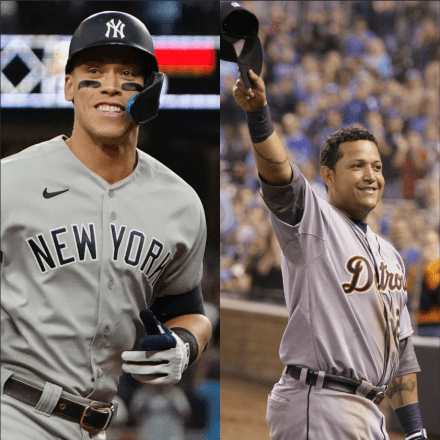
62 Home Runs? Meh

Aaron Judge just finished a season for the ages. He came 4 hits shy of the Triple Crown and will almost certainly win the American League MVP award, deservedly so, as he practically single-handedly carried a New York Yankees team that cratered in the second half of the season to the division title.

But since he didn’t win the Triple Crown, his amazing season will be boiled down to the fact that he hit 62 home runs, breaking the Yankees and American League records.

That achievement is largely meaningless.

Wait, what?

Yes, 62 home runs is amazing. There have only been 6 seasons (by 3 players) where someone hit more than those 62 dingers. But based on the media coverage, you would think he’s personally saved baseball by erasing the tainted marks of the steroid era and establishing the “real” home run record.

It’s absurd.

I could find you any number of articles and videos of otherwise intelligent journalists and talking heads arguing that Judge has now set the “real” record. Roger Maris Jr. famously proclaimed Judge to be the real record holder, as if his familial link to the guy who held the record for 37 years makes him the arbiter of baseball’s single-season home run champion, and not someone who just realized he’s lost any reason to be invited to games for free as the representative of his father’s achievement. But it was really one column that made my blood boil and inspired me to sit down and put together this post.

On Tuesday, before Judge had hit his 62nd homer, Eric Blum of Deadspin wrote a column discussing what a disappointment it would be if Judge couldn’t hit the momentous home run, and proclaimed that should he finish the job it would be the “biggest single achievement in baseball in two decades”. A great achievement? Yes. The “biggest single achievement in baseball in two decades”? Not so fast my friend.

History Lesson Part 1

Babe Ruth set the single-season home run record 3 consecutive years from 1919-1921 before setting the seemingly insurmountable record of 60 in 1927. That record stood for 34 years until Roger Maris hit 61 in 1961. His record somehow lasted longer than Ruth’s, until Mark McGwire (70) and Sammy Sosa (66) broke it 37 years later in 1998. McGwire would add a season of 65 homers in 1999, and Sosa would hit 63 in 1999 and 64 in 2001 before Barry Bonds came along and hit 73 in 2001 to establish the current Major League record, which has now stood for 21 years.

By the way, how much did it have to suck for Sosa to have a four season stretch where he hit 66, 63, 50, and 64 home runs, and aside from a 45-minute span where he beat McGwire to 66 home runs in ’98, he never held the home run record?

Defending the Triple Crown

Hitting 60 home runs is hard – it’s only happened nine times in the history of baseball. Hell, hitting 50 home runs has only happened 47 times, so I’m not diminishing what Judge has done this season. But almost as rare as the 60 home run season is the batting Triple Crown, which has happened 12 times since baseball recognized RBI in 1920, and the most recent winner broke the longest Triple Crown drought in the game’s history – longer than any gap between home run records being established.

So it should come as no great surprise that a blog that makes no effort to hide its obvious Detroit bias would dedicate a post to defending Miguel Cabrera’s 2012 American League Triple Crown as the “biggest single achievement in baseball in two decades”.

(In actuality, I’m going to argue that his 2013 follow-up season was the more impressive feat.)

Cabrera became the first player in 45 years to win the Triple Crown in 2012, finishing with a .330 average, 44 home runs, and 139 RBI. What people who are not obsessive fans of the Detroit Tigers may not realize is that his 2013 season was perhaps more impressive.

History Lesson Part 2

There have been 12 Triple Crowns in the American and National Leagues since 1920 (a significant starting point since it heralded the end of the dead ball era and the official creation of the run batted in). There were 5 Triple Crown seasons in the AL, NL, and the old American Association prior to 1920, as well as 10 Triple Crown winners in the Negro Leagues. Of those 27 seasons, only one man – Josh Gibson in 1936 and 1937 – won the Triple Crown in back-to-back seasons.

(Because of the shorter seasons in the “official” Negro Leagues and the pre-1901 Major Leagues, and the deadened ball that required a significantly different style of play prior to 1920, I am not considering these 15 seasons on par with the AL/NL achievements and thus not including any analysis here. If you don’t like that…well, you do the work.)

Of those 12 AL/NL Triple Crown Seasons, 9 were followed up by seasons where the winner finished in the top 10 in the 3 categories the next season, and 10 were preceded by such seasons. To determine how close someone came to repeating as Triple Crown champion, I added their finish in the respective statistical categories to come up with a “Triple Crown rank”. For example, someone who finished first in average, second in home runs, and third in RBI would have a Triple Crown rank of 6. The lower the number the better, with a Triple Crown winner having a rank of 3.

The closest anyone has come to winning back-to-back Crowns was Jimmie Foxx in 1932 and 1933. Foxx missed out on the Triple Crown in 1932 by 2 hits, losing the batting title to Dale Alexander by just over 3 points while leading the league in homers and RBI, before winning the Crown in 1933. Worth noting is that Foxx played all 154 games in 1932, while Alexander missed 30 games and had 248 fewer plate appearances than Foxx did. Kinda feels like the real Jimmy Dugan got the shaft.

Rogers Hornsby led in average and RBI in 1921, but missed out on back-to-back Crowns by 2 home runs, which preceded him achieving the feat in 1922. But in both the Foxx and Hornsby cases, the near-miss on the Triple Crown preceded them finishing the job the following season.

Among players looking to repeat as Triple Crown champion, prior to 2012, only 3 seasons saw someone register a Triple Crown rank of 10 or lower:

  • In 1948, Ted Williams won the batting title, and finished 14 HR and 28 RBI behind the champions. Not particularly close.
  • Frank Robinson followed up his 1967 Triple Crown by finishing second in average (5 hits shy), fourth in homers (14 HR behind), and third in RBI (27 RBI short) in 1968. Again, not a significant threat to go back-to-back.
  • Williams should be considered the closest to repeating as Triple Crown champion, as he followed up his first Crown in 1942 by finishing second in each category, 6 hits, 6 home runs, and 4 RBI behind the champions. There’s a caveat to that though: Williams’s follow-up season came in 1946, as he spent 1943-45 serving in World War II.

Back to Miggy

After Cabrera won the first Triple Crown in 45 years in 2012, he arguably had a better season in 2013. He hit the same number of home runs, had 2 fewer RBI, and improving his slash line from .330/.393/.606/.999 to .348/.442/.636/1.078. He repeated as batting champion, and finished second in homers and RBI. But his chase to repeat could have ended much differently.

On August 26 of that season, Cabrera trailed Chris Davis by 3 home runs, 46 to 43, and had 130 RBI to Davis’s 118. A repeat Triple Crown was within reach. But a nagging injury that required surgery following the season led to him hitting only 1 more home run and tallying just 7 RBI over the last 31 games of the season (6 of which Cabrera missed entirely). Miggy would miss fall 9 short of the home run title and lose the RBI title on the last day of the season, but his Triple Crown rank of 5 would be the lowest of any player looking to repeat the feat.

The Elephant in the Room

Back to the home run hitters. Obviously, I’m somewhat intentionally leaving out the significant fact that the three players who hit more home runs than Judge are all tainted by the steroids scandal of the late-’90s and early-2000s. I’m not naïve enough to pretend it didn’t happen or that they didn’t cheat. To do so would be idiotic.

But the fact is that the usage of steroids – while certainly illegal when Bonds, Sosa, and McGwire were playing – wasn’t tested for, and in fact was tacitly endorsed by Major League Baseball itself. MLB needed a draw to bring fans back to the game after the owner-forced players’ strike in 1994-95 wiped out the World Series, and a chase for the most hallowed record in sports was just the thing for people to fall in love with baseball again. Baseball was all too happy to embrace McGwire and Sosa in 1998, with the public vilifying a member of the press who pointed out that McGwire had a substance that is now banned (but was legal then) in his locker for all to see. It was only after steroids became a great public scourge that MLB would throw all the drug cheats under the bus, making no mention of the incalculable sum of money the owners (and players, to be fair) pocketed off all those home runs.

So the simple fact is, those homers happened. They happened against pitchers who were using steroids. Baseball has never made any effort to vacate the numbers from the steroid era. There are no asterisks. McGwire broke Maris’s record by launching 70 balls into the stands in 1998, and then Bonds one-upped him with 73 homers three years later. There’s no denying that those home runs happened. The purist can sit there and bloviate about how they don’t recognize the steroid cheats, but as long as I can go to Baseball Reference and see that Barry Bonds hit 73 home runs in 2001 and 762 for his career, those are the records.

(And don’t talk to me about the purity of the other records. Babe Ruth’s only at bats against black players were in exhibitions and Roger Maris was a lefty hitting to a right field fence that was 296 feet from home plate.)

Is 62 That Hard?

Now that I’ve so eloquently and obviously explained why Bonds is clearly the all-time home run champion, it’s time to go back and look at how impressive Judge’s achievement was this season, and whether it truly is the “biggest single achievement in baseball in two decades”.

Since Bonds hit 73 in 2001, guys like Giancarlo Stanton, Ryan Howard, Pete Alonso, Jim Thome, Andruw Jones, and Prince Fielder have all hit 50 or more home runs in a season. Judge himself did it in his rookie year, setting the rookie record (which Alonso would beat 2 years later). None of these guys have ever been accused of any kind of steroid link.

But wait, these guys hit 50, right? 50 is not 60 (that’s your math lesson for the day). No, it’s not, but let’s look at Giancarlo Stanton’s 2017 season. Stanton hit 59 home runs, 31 of them at home in a park that was less homer friendly compared to a neutral park. Judge this season hit 30 of his 62 at Yankee Stadium, which saw home runs hit at a pace just above league average. If you were to normalize them to a league average park, Judge could be expected to hit roughly the same number of home runs, but Stanton would pick up about 6 more home runs, so 62 was not out of the question.

Let’s go back to the McGwire and Sosa in 1998. Much like Maris did in 1961, McGwire and Sosa had their magical 1998 seasons in an expansion year. When expansion happens, there’s an influx of pitchers of lesser quality who would otherwise not be in the Majors; pitchers who otherwise wouldn’t be in the Majors result in more offense, and thus more home runs. McGwire broke Maris’s record by 9 home runs, adding 14.75% to the record. By contrast, Maris broke Ruth’s record by 1 home run, and that’s with an additional 8 games on the schedule (resulting in an asterisk actually being added to Maris’s record, albeit by a crony of Ruth’s who was bitter that the Babe’s record was broken). Were steroids a contributing factor to the number of home runs McGwire and Sosa hit? Undoubtedly. Is it as significant a factor as the reduction in quality pitching that came about because of expansion? I’m not so sure, so again, even if McGwire and Sosa were clean, 62 home runs was definitely in play.

Barry Bonds is tougher to defend. Bonds is arguably one of the greatest hitters that ever lived, but his peak came right at the height of his steroid use. Still, it’s well established that Bonds began using steroids in response to seeing McGwire and Sosa – 2 players he (justifiably) viewed as inferior to him – getting all the attention for breaking the home run record. It’s not unreasonable to think, even in a clean game, Bonds focuses his efforts toward home runs instead of being an all-around hitter, and makes a run at whatever the record stood at after 1998.

Simply put, even with no steroid taint on the guys ahead of Judge, I think it’s still highly likely that someone – if not multiple people – would have broken Maris’s home run record in the now 61 years since he set the record.

The Rarity of the Triple Crown

OK, but even allowing for assumptions that some players would have hit 62 home runs anyway, or would’ve done it in a different park, that’s still only 5-7 players who would have hit 62 home runs since Maris.

True, but since World War II, only 5 guys have completed the Triple Crown (Ted Williams in ’47, Mickey Mantle in ’56, Frank Robinson in ’66, Carl Yastrzemski in ’67, and Miguel Cabrera in 2012). While Ruth’s record stood for 34 years and Maris’s for 37, there was a 45 year gap between Yastrzemski and Cabrera, and no one has completed the Triple Crown in the National League in 85 years.

There have been close calls in that time. Jim Rice finished 3rd in batting average while winning the home run and RBI titles in 1978. Gary Sheffield made a run in 1992, but finished 2 home runs and 9 RBI short. Vlad Guerrero Jr. made a run in 2021 before falling short in average and RBI. Paul Goldschmidt and Judge led all three categories at points throughout the 2022 season, with Judge only losing his lead in average in the final week of the season.

But this just proves how difficult it is to pull off the feat, and what makes Cabrera pulling it off in 2012 (and almost doing it again in 2013) so impressive. When something’s only happened once in the last 55 years, I’m giving it my vote as the “biggest single achievement in baseball in two decades”. And I’d say that even if Judge had finished the job this year (twice in 55 years makes it only marginally less impressive) or if someone other than a Tiger had pulled it off in 2012.

So Why the Hype for 62?

Look, I’m not downplaying what Judge did this season. Hitting 62 home runs is not an insignificant achievement, and doing it while also almost pulling off the Triple Crown, on top of carrying your team over the finish line to the playoffs, makes it all the more impressive.

But his chase for 62 was not worthy of the press coverage it received. Once Judge got to 60, ESPN started to cut in to regular programming for every one of Judge’s at-bats, acting as though Judge setting the Yankee and American League records were worthy of such treatment. Would you expect this much coverage for someone setting the AFC single-season rushing record?

(Yes, I realize the baseball leagues have historically been more distinctly separate than the conferences from the other leagues have been, but we’re well past the point where an American League record had any great significance.)

ESPN, Fox, and Major League Baseball made untold millions covering and promoting the home run chase in 1998, and Bonds’s subsequent chases in 2001 and 2007. Then they made untold millions more covering the fallout from the steroids era (less so for MLB in this case). Now they’re making untold millions more acting like 1998 never happened, allowing their talking heads to feed the phony 24-hour sports news cycle by screaming like lunatics about what the “real” home run record is. It’s bullshit.

It’s pretty simple. Judge hit 62. Sosa hit 63, 64, and 66. McGwire hit 65 and 70. Bonds hit 73. Those balls aren’t coming out of the seats because you want to punish the players but not the league. Someone wants to pay $2 million for the Judge ball? Fine. I say they’re idiots.

And what Miguel Cabrera did was more impressive than all of them.

So Your Bracket’s Busted… (Redux)

deflatedbb2

When I was a senior in high school, our football team went to the state finals.  The school had never been to the playoffs, let alone the finals, so this was a HUGE deal.  And because I love sports but wasn’t on the football team for a myriad of reasons, including, but not limited to, being afraid of asking anyone for a ride home after practice; not being overly enamored with the idea of pain; and generally being terrible at anything that required athletic ability, I wrote for the school newspaper about the team instead.

The West Beverly Blaze this was not.  If we put out one issue a month, it was considered productive.  But because of the unprecedented success of our football team, we somehow managed to put out a new issue after each round of the playoffs – four straight weeks.  Because high school students have ambition these days, I’m guessing that isn’t that much of an accomplishment, even at a terrible school like mine, but in our day it was an achievement.

I tell you that story because I’m coming back to you a scant 3 days after my last post for a new display of my inane ramblings.  And why?  Because of my unprecedentedly terrible picking of my desired Final Four matchups.

In my last post, I decided that I wanted to see Nevada, Texas A&M, Purdue, and Clemson to make the Final Four.  None of these teams would be considered the favorites in their respective brackets, but considering how crazy this tournament has been, I expected maybe one of them to sneak through to San Antonio.  Or hell, at least survive the Sweet 16.

Nope.  Not a one.  Somehow, all four of my teams lost on Thursday and Friday nights.  Now, I don’t know how to calculate probabilities, so I can’t tell whether the chances of this happening were 50% or 0.00001%, but I picked a couple of higher seeds in there.  I would’ve thought Purdue would’ve snuck through to take on Villanova.

Ugh.

So we’re trying this again.  If you’re looking for gambling advice, never come to me.

South Region

#9 Kansas State vs. #11 Loyola-Chicago: for some reason I don’t like Kansas State’s basketball team.  Maybe it was because they hired Bob Huggins for his 1-year “redemption tour” stint after he was fired at Cincinnati.  Maybe it’s that the group of fans I mentioned in my last post really annoyed me.  I don’t know what it is, just not a fan.

At the same time, there’s something disappointing about the fact that I know all about Sister Jean and her brackets but I couldn’t tell you the name of a single Loyola player or coach.  The human interest story has gone a little overboard.  So this one’s a coin toss.

The pick: Heads…Loyola-Chicago it is.

West Region

#9 Florida State vs. #3 Michigan: I’ve got a few thoughts over the local fan reactions to Michigan’s trouncing of Texas A&M on Thursday.  But they beat us twice, they’re a win away from the Final Four, and considering what their side of the bracket looks like, if they don’t make the final this year their season is going to be almost as disappointing as Michigan State’s.  So I’ll keep my mouth shut and avoid being called out for sour grapes.

But I’m not rooting for them.

(Also, seriously, a 5-year-old girl has a chance at winning our pool because she picked Florida State to win it all.  I mean, how cool would that be?)

The pick: Florida State

East Region

#1 Villanova vs. #3 Texas Tech: Detroit is currently in a remarkable tailspin when it comes to sports.  The Red Wings and Pistons are terrible.  The Tigers unloaded everyone except Miguel Cabrera, and that’s only because his contract is atrocious.  We are legitimately at a time where our best chance at a championship is the Lions, and the only thing more ridiculous in all of sports would be if the Browns were Cleveland’s best hope.

So I’m not going to throw my support behind a team from a town that just hoisted the Lombardi Trophy.  I know Philly has something like 14 college teams so the city’s loyalties are somewhat split, but so is Detroit’s.  It’s a good enough excuse for me.

The pick: Texas Tech

Midwest Region

#1 Kansas vs. #2 Duke: I have become resigned to the fact that the national title game this year is going to be Duke versus Michigan.  It’s just the way it has to be.  It will be my punishment for being so overly confident about a team that never really deserved it.  And because I no longer have any chance at winning any money in my bracket, I will probably find myself rooting for Michigan and being a traitor to the Spartan cause.

Serves me right.

The pick: Kansas

So there you have it…again.  My (revised) picks for the Final Four are Loyola-Chicago, Florida State, Texas Tech, and Kansas.  And amazingly, I don’t believe any of these teams will be favorites in their Elite 8 games this weekend.

Place your bets accordingly.

Fixing Major League Baseball

1986

We’re a week into the Major League Baseball season (at least we are when I started writing this, with my writing prowess it could be the All-Star break before this actually gets published), and it’s time to revisit one of my favorite pieces of this blog – fixing something that really isn’t broken.

Baseball’s a phenomenal sport, and reports of its demise are greatly exaggerated.  It will never overtake the NFL – well, at least not until someone dies on the gridiron and the masses flee in droves – but it’s also never going to lose its ground to the NBA or NHL.  That said, there are still some relatively simple fixes that will make a great game even greater.  Without further ado:

Expansion/Contraction

A fair number of my suggestions will require an even number of teams in each League, so we should address the expansion/contraction of teams first.  My personal opinion is that there are 2 too many teams in baseball, and the stadium situations in Oakland and Tampa Bay prove that out.  If it were up to me, we’d contract the 2 teams that have never been to the World Series – the Seattle Mariners and the Washington Nationals – and move the Rays and A’s to those respective cities for the sake of franchise continuity (I’m a history geek like that).

But since we know that, barring a catastrophic financial situation – like, say, the bursting of the television rights fee bubble – no professional league is going to contract its teams, so let’s add teams in Montreal and Charlotte or Portland and call it good.

On Field Improvements

Universal Designated Hitter

Major League Baseball is the only sport on the planet (i.e., in the U.S., which is all that matters, amirite?) where half the league plays by one set of rules and the other half plays by another.  With year-round interleague play (we’ll get to that in a minute), that means a team built to play with the designated hitter may have to play a season-ending series with the playoffs on the line with their DH on the bench.  And anyone who’s ever seen Justin Verlander swing a bat knows that you’d much rather have Victor Martinez batting in a big situation.

So we’re changing the rules and either eliminating the DH or making it universal.  And while we can all marvel at Madison Bumgarner’s home run hitting ability, we tend to ignore the fact that he’s a career .186 hitter, and he’s the best hitting pitcher.  The simple fact is that watching a pitcher swing the bat is generally boring and painful (Bartolo Colon notwithstanding), and it leads to ridiculous managerial decisions where a guy throwing a shutout is pulled for a pinch hitter after 73 pitches because the offense can’t put up any runs.  No, it’s time for the NL’s antiquated rules to go by the wayside and MLB to adopt the DH permanently.  The fans will love it, the players will love it (more money for aging veterans to finish out their careers), and the owners…well, screw the owners.

Pitch Clock

I’ll get push back here – and I know this because I got plenty of push back from a buddy of mine when we were discussing it on Opening Day – but for a league that’s attempting to cut the length of their games so Millennials with attention spans measuring in nanoseconds can stay engaged, the pitch clock makes too much sense not to happen.

You can’t implement the pitch clock with men on base, because there are too many variables with that baserunner to force the pitcher to stick to a clock without disrupting his rhythm or making a stupid mistake.  But when there’s no one on base, there’s no reason a pitcher (or a batter) needs more than 20 seconds to make the next pitch.  Start the clock when the catcher receives the pitch, and if the umpire determines that the batter or pitcher is stalling, they’re punished with a ball or a strike against them.

Automated Balls/Strikes

In 2017, when anyone with a smartphone has access to PitchFX that shows exactly where every ball crosses the plate, there’s absolutely no reason for a human being to call balls and strikes.  Talk to me all you want about the human element, but I don’t want the game determined because some umpire didn’t see where the ball went across the plate.  The “human element” applies to the players; fair or not, the officiating of a game needs to be as close to perfect as possible.

With so few baseball calls being truly subjective – especially now that they’ve gotten rid of the neighborhood play on double plays – I’d argue that all officiating could be automated, but let’s start with baby steps.

Overhaul Instant Replay

Aside from Screech on Saved by the Bell, there’s not a person on Earth who has ever watched a game because of who’s officiating that game.  And yet we give the teams challenges to question when an umpire might have made an incorrect call, instead of insisting that the calls just be right.  So we’re going to remove the challenge system and put a fifth (or, in the case of postseason play, seventh) umpire in the broadcast booth, and if an umpire screws up, that extra umpire is going to correct him.  We’re not going to continue to allow the umpires’ egos to determine whether or not a game gets called correctly.

Drastically Reduce Ejections

Some ejections are deserved – I’m looking at you Bryce Harper.  But in a lot of cases a batter will question a call just a little bit more emphatically than the umpire likes (although not at all egregiously), and he’s gone.  The problem is that it drastically reduces the flexibility of the manager, and if someone like Miguel Cabrera gets ejected and has to be replaced by Andrew Romine, the strategy for the remainder of the game is changed immensely.  So unless someone is risking physical harm to another player or an umpire, or truly making an ass out of himself, we’re going to keep the Umpshow to a minimum.

Scheduling

154-Game Schedule

The owners will never go for it.  The players will love it.  Eliminate 8 games from the season to return to what was standard prior to expansion in 1961.  If you want to placate the owners, increase the cost of everything by 5%.  Well, everything except my beer.

Eliminate Interleague Play

Interleague play is over.  It’s played out.  It was never particularly interesting to start, and it ruined the truly novel approach that only MLB had – namely, that the two teams that met in the World Series had not met in the regular season.  MLB loved the “natural” rivalries in New York, Los Angeles, Chicago, Florida, and a few other places, but they didn’t account for truly dreadful games like Padres-Mariners.  And because the interleague games all took place on designated summer weekends when the weather was nice and the rivalry games were naturally more appealing to the local fans, MLB could proclaim that interleague games were more popular than your average American League or National League games.  It’s worth pointing out that since they’ve gone to year-round interleague play, we haven’t seen proclamations about the popularity of the games, likely because that April Marlins-Orioles game is dragging down the average.

Balanced Schedule

With 16 teams in each league, a 154-game schedule, and the elimination of interleague play, you can play 10 games against each team with 4 games left over.  The remaining 4 games can be rotated among the teams on an annual basis, or you could add a series based upon where the teams finished the previous season (for example, the best team plays the second best team, third place plays fourth place, etc.).  Either way, it’s better than 19 Royals-White Sox games a year.

Holiday Doubleheaders

There are 5 “major” holidays throughout the baseball season: Mother’s Day, Memorial Day, Father’s Day, Independence Day, and Labor Day.  We’ll throw out Mother’s Day and Father’s Day since those are Sundays by rule and thus travel days.  But every team is required to play doubleheaders on 2 of the remaining 3 holidays – one at home, and one on the road.  If that holiday falls on a Sunday, the doubleheader will revert to the previous Saturday.  The players hate doubleheaders, but we’ve just cut 8 games out of the schedule, so they’ll get used to it.

Beginning/End of Season

Every season begins on the first Monday in April.  If you want to cater to ESPN and have them air a Sunday night game the night before, fine.  But this year there were 3 Sunday games to start the season, and that’s just insane.  One’s enough as a showcase for the game.

And since we’ve cut 8 games, plus 2 additional days of game play via the new doubleheader rule, there’s no excuse to be playing games in November.

Playoff Scheduling

Major League Baseball has deduced that playing 4 straight Division Series games on a Thursday will garner more television viewers than running 2 games simultaneously.  This seems dubious to me, but I’ve tended to default to the position of, “Someone smarter than me is making that determination.”  I mean, they have to be, right?

Still, it sucks for the fans with tickets.  Because the playoff schedule isn’t set until a day or two before the games start, you could wind up buying a ticket to a noon playoff game that you can’t use because you can’t get off work.  So either show the fans that there truly are more viewers for a Thursday noon game than there are for 2 games airing simultaneously, or cut out the weekday afternoon games.

Also, while I understand that games involving teams from New York and Chicago are going to garner more viewers than Oakland or Tampa Bay games will, it’s kind of crappy when all of the Oakland League Championship Series games get relegated to the 4pm games.  So alternate the LCS games so that both teams get prime time treatment.

Playoff Determinations

Realignment

In 2015, the three best teams in all of baseball all played in the National League Central.  The St. Louis Cardinals won the division with 100 wins, while the Cubs (97 wins) and Pirates (98) were subjected to a 1-game playoff to determine who moved on.  The Pirates and Cubs were punished because they were geographically close to the Cardinals.  And just to add insult to injury, because the team with the best regular season record automatically plays the winner of the Wild Card game in the Division Series, the Cardinals were punished by having to play the a 97-win team instead of the 92-win Dodgers or 90-win Mets.  This is asinine.  The best teams should be rewarded for having a superior regular season.  So we’re eliminating divisions.  Two Leagues, 16 teams each, with a balanced schedule.

Oh, and the Brewers and Astros are going back where they belong.

Playoff Seeding

Playoff seeding is simple: the top 5 teams in each League make the playoffs.  The top 3 teams get a bye to the Division Series while the 4th and 5th place teams play the Wild Card game to move on.  There’s no reason to reward a team for being located in a geographically advantageous location.

Conclusion

I’ll admit that a lot of these rule changes seek to fix some of the quirks that make baseball “great”.  Fans love to see pitchers hit dingers and the Wild Card situation I discussed isn’t particularly common.  But the Giants can still refuse the DH to let Bumgarner hit (which they’ve already done in interleague games), and no one’s going to weep because we close a loophole to give an advantage to a better team.

And I’m not going to stop watching because these rule changes aren’t made (because, let’s face it, most of them won’t be), but we could definitely make the game better.