62 Home Runs? Meh

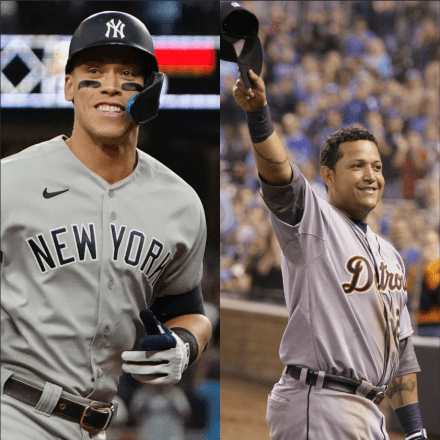
Aaron Judge just finished a season for the ages. He came 4 hits shy of the Triple Crown and will almost certainly win the American League MVP award, deservedly so, as he practically single-handedly carried a New York Yankees team that cratered in the second half of the season to the division title.

But since he didn’t win the Triple Crown, his amazing season will be boiled down to the fact that he hit 62 home runs, breaking the Yankees and American League records.

That achievement is largely meaningless.

Wait, what?

Yes, 62 home runs is amazing. There have only been 6 seasons (by 3 players) where someone hit more than those 62 dingers. But based on the media coverage, you would think he’s personally saved baseball by erasing the tainted marks of the steroid era and establishing the “real” home run record.

It’s absurd.

I could find you any number of articles and videos of otherwise intelligent journalists and talking heads arguing that Judge has now set the “real” record. Roger Maris Jr. famously proclaimed Judge to be the real record holder, as if his familial link to the guy who held the record for 37 years makes him the arbiter of baseball’s single-season home run champion, and not someone who just realized he’s lost any reason to be invited to games for free as the representative of his father’s achievement. But it was really one column that made my blood boil and inspired me to sit down and put together this post.

On Tuesday, before Judge had hit his 62nd homer, Eric Blum of Deadspin wrote a column discussing what a disappointment it would be if Judge couldn’t hit the momentous home run, and proclaimed that should he finish the job it would be the “biggest single achievement in baseball in two decades”. A great achievement? Yes. The “biggest single achievement in baseball in two decades”? Not so fast my friend.

History Lesson Part 1

Babe Ruth set the single-season home run record 3 consecutive years from 1919-1921 before setting the seemingly insurmountable record of 60 in 1927. That record stood for 34 years until Roger Maris hit 61 in 1961. His record somehow lasted longer than Ruth’s, until Mark McGwire (70) and Sammy Sosa (66) broke it 37 years later in 1998. McGwire would add a season of 65 homers in 1999, and Sosa would hit 63 in 1999 and 64 in 2001 before Barry Bonds came along and hit 73 in 2001 to establish the current Major League record, which has now stood for 21 years.

By the way, how much did it have to suck for Sosa to have a four season stretch where he hit 66, 63, 50, and 64 home runs, and aside from a 45-minute span where he beat McGwire to 66 home runs in ’98, he never held the home run record?

Defending the Triple Crown

Hitting 60 home runs is hard – it’s only happened nine times in the history of baseball. Hell, hitting 50 home runs has only happened 47 times, so I’m not diminishing what Judge has done this season. But almost as rare as the 60 home run season is the batting Triple Crown, which has happened 12 times since baseball recognized RBI in 1920, and the most recent winner broke the longest Triple Crown drought in the game’s history – longer than any gap between home run records being established.

So it should come as no great surprise that a blog that makes no effort to hide its obvious Detroit bias would dedicate a post to defending Miguel Cabrera’s 2012 American League Triple Crown as the “biggest single achievement in baseball in two decades”.

(In actuality, I’m going to argue that his 2013 follow-up season was the more impressive feat.)

Cabrera became the first player in 45 years to win the Triple Crown in 2012, finishing with a .330 average, 44 home runs, and 139 RBI. What people who are not obsessive fans of the Detroit Tigers may not realize is that his 2013 season was perhaps more impressive.

History Lesson Part 2

There have been 12 Triple Crowns in the American and National Leagues since 1920 (a significant starting point since it heralded the end of the dead ball era and the official creation of the run batted in). There were 5 Triple Crown seasons in the AL, NL, and the old American Association prior to 1920, as well as 10 Triple Crown winners in the Negro Leagues. Of those 27 seasons, only one man – Josh Gibson in 1936 and 1937 – won the Triple Crown in back-to-back seasons.

(Because of the shorter seasons in the “official” Negro Leagues and the pre-1901 Major Leagues, and the deadened ball that required a significantly different style of play prior to 1920, I am not considering these 15 seasons on par with the AL/NL achievements and thus not including any analysis here. If you don’t like that…well, you do the work.)

Of those 12 AL/NL Triple Crown Seasons, 9 were followed up by seasons where the winner finished in the top 10 in the 3 categories the next season, and 10 were preceded by such seasons. To determine how close someone came to repeating as Triple Crown champion, I added their finish in the respective statistical categories to come up with a “Triple Crown rank”. For example, someone who finished first in average, second in home runs, and third in RBI would have a Triple Crown rank of 6. The lower the number the better, with a Triple Crown winner having a rank of 3.

The closest anyone has come to winning back-to-back Crowns was Jimmie Foxx in 1932 and 1933. Foxx missed out on the Triple Crown in 1932 by 2 hits, losing the batting title to Dale Alexander by just over 3 points while leading the league in homers and RBI, before winning the Crown in 1933. Worth noting is that Foxx played all 154 games in 1932, while Alexander missed 30 games and had 248 fewer plate appearances than Foxx did. Kinda feels like the real Jimmy Dugan got the shaft.

Rogers Hornsby led in average and RBI in 1921, but missed out on back-to-back Crowns by 2 home runs, which preceded him achieving the feat in 1922. But in both the Foxx and Hornsby cases, the near-miss on the Triple Crown preceded them finishing the job the following season.

Among players looking to repeat as Triple Crown champion, prior to 2012, only 3 seasons saw someone register a Triple Crown rank of 10 or lower:

  • In 1948, Ted Williams won the batting title, and finished 14 HR and 28 RBI behind the champions. Not particularly close.
  • Frank Robinson followed up his 1967 Triple Crown by finishing second in average (5 hits shy), fourth in homers (14 HR behind), and third in RBI (27 RBI short) in 1968. Again, not a significant threat to go back-to-back.
  • Williams should be considered the closest to repeating as Triple Crown champion, as he followed up his first Crown in 1942 by finishing second in each category, 6 hits, 6 home runs, and 4 RBI behind the champions. There’s a caveat to that though: Williams’s follow-up season came in 1946, as he spent 1943-45 serving in World War II.

Back to Miggy

After Cabrera won the first Triple Crown in 45 years in 2012, he arguably had a better season in 2013. He hit the same number of home runs, had 2 fewer RBI, and improving his slash line from .330/.393/.606/.999 to .348/.442/.636/1.078. He repeated as batting champion, and finished second in homers and RBI. But his chase to repeat could have ended much differently.

On August 26 of that season, Cabrera trailed Chris Davis by 3 home runs, 46 to 43, and had 130 RBI to Davis’s 118. A repeat Triple Crown was within reach. But a nagging injury that required surgery following the season led to him hitting only 1 more home run and tallying just 7 RBI over the last 31 games of the season (6 of which Cabrera missed entirely). Miggy would miss fall 9 short of the home run title and lose the RBI title on the last day of the season, but his Triple Crown rank of 5 would be the lowest of any player looking to repeat the feat.

The Elephant in the Room

Back to the home run hitters. Obviously, I’m somewhat intentionally leaving out the significant fact that the three players who hit more home runs than Judge are all tainted by the steroids scandal of the late-’90s and early-2000s. I’m not naïve enough to pretend it didn’t happen or that they didn’t cheat. To do so would be idiotic.

But the fact is that the usage of steroids – while certainly illegal when Bonds, Sosa, and McGwire were playing – wasn’t tested for, and in fact was tacitly endorsed by Major League Baseball itself. MLB needed a draw to bring fans back to the game after the owner-forced players’ strike in 1994-95 wiped out the World Series, and a chase for the most hallowed record in sports was just the thing for people to fall in love with baseball again. Baseball was all too happy to embrace McGwire and Sosa in 1998, with the public vilifying a member of the press who pointed out that McGwire had a substance that is now banned (but was legal then) in his locker for all to see. It was only after steroids became a great public scourge that MLB would throw all the drug cheats under the bus, making no mention of the incalculable sum of money the owners (and players, to be fair) pocketed off all those home runs.

So the simple fact is, those homers happened. They happened against pitchers who were using steroids. Baseball has never made any effort to vacate the numbers from the steroid era. There are no asterisks. McGwire broke Maris’s record by launching 70 balls into the stands in 1998, and then Bonds one-upped him with 73 homers three years later. There’s no denying that those home runs happened. The purist can sit there and bloviate about how they don’t recognize the steroid cheats, but as long as I can go to Baseball Reference and see that Barry Bonds hit 73 home runs in 2001 and 762 for his career, those are the records.

(And don’t talk to me about the purity of the other records. Babe Ruth’s only at bats against black players were in exhibitions and Roger Maris was a lefty hitting to a right field fence that was 296 feet from home plate.)

Is 62 That Hard?

Now that I’ve so eloquently and obviously explained why Bonds is clearly the all-time home run champion, it’s time to go back and look at how impressive Judge’s achievement was this season, and whether it truly is the “biggest single achievement in baseball in two decades”.

Since Bonds hit 73 in 2001, guys like Giancarlo Stanton, Ryan Howard, Pete Alonso, Jim Thome, Andruw Jones, and Prince Fielder have all hit 50 or more home runs in a season. Judge himself did it in his rookie year, setting the rookie record (which Alonso would beat 2 years later). None of these guys have ever been accused of any kind of steroid link.

But wait, these guys hit 50, right? 50 is not 60 (that’s your math lesson for the day). No, it’s not, but let’s look at Giancarlo Stanton’s 2017 season. Stanton hit 59 home runs, 31 of them at home in a park that was less homer friendly compared to a neutral park. Judge this season hit 30 of his 62 at Yankee Stadium, which saw home runs hit at a pace just above league average. If you were to normalize them to a league average park, Judge could be expected to hit roughly the same number of home runs, but Stanton would pick up about 6 more home runs, so 62 was not out of the question.

Let’s go back to the McGwire and Sosa in 1998. Much like Maris did in 1961, McGwire and Sosa had their magical 1998 seasons in an expansion year. When expansion happens, there’s an influx of pitchers of lesser quality who would otherwise not be in the Majors; pitchers who otherwise wouldn’t be in the Majors result in more offense, and thus more home runs. McGwire broke Maris’s record by 9 home runs, adding 14.75% to the record. By contrast, Maris broke Ruth’s record by 1 home run, and that’s with an additional 8 games on the schedule (resulting in an asterisk actually being added to Maris’s record, albeit by a crony of Ruth’s who was bitter that the Babe’s record was broken). Were steroids a contributing factor to the number of home runs McGwire and Sosa hit? Undoubtedly. Is it as significant a factor as the reduction in quality pitching that came about because of expansion? I’m not so sure, so again, even if McGwire and Sosa were clean, 62 home runs was definitely in play.

Barry Bonds is tougher to defend. Bonds is arguably one of the greatest hitters that ever lived, but his peak came right at the height of his steroid use. Still, it’s well established that Bonds began using steroids in response to seeing McGwire and Sosa – 2 players he (justifiably) viewed as inferior to him – getting all the attention for breaking the home run record. It’s not unreasonable to think, even in a clean game, Bonds focuses his efforts toward home runs instead of being an all-around hitter, and makes a run at whatever the record stood at after 1998.

Simply put, even with no steroid taint on the guys ahead of Judge, I think it’s still highly likely that someone – if not multiple people – would have broken Maris’s home run record in the now 61 years since he set the record.

The Rarity of the Triple Crown

OK, but even allowing for assumptions that some players would have hit 62 home runs anyway, or would’ve done it in a different park, that’s still only 5-7 players who would have hit 62 home runs since Maris.

True, but since World War II, only 5 guys have completed the Triple Crown (Ted Williams in ’47, Mickey Mantle in ’56, Frank Robinson in ’66, Carl Yastrzemski in ’67, and Miguel Cabrera in 2012). While Ruth’s record stood for 34 years and Maris’s for 37, there was a 45 year gap between Yastrzemski and Cabrera, and no one has completed the Triple Crown in the National League in 85 years.

There have been close calls in that time. Jim Rice finished 3rd in batting average while winning the home run and RBI titles in 1978. Gary Sheffield made a run in 1992, but finished 2 home runs and 9 RBI short. Vlad Guerrero Jr. made a run in 2021 before falling short in average and RBI. Paul Goldschmidt and Judge led all three categories at points throughout the 2022 season, with Judge only losing his lead in average in the final week of the season.

But this just proves how difficult it is to pull off the feat, and what makes Cabrera pulling it off in 2012 (and almost doing it again in 2013) so impressive. When something’s only happened once in the last 55 years, I’m giving it my vote as the “biggest single achievement in baseball in two decades”. And I’d say that even if Judge had finished the job this year (twice in 55 years makes it only marginally less impressive) or if someone other than a Tiger had pulled it off in 2012.

So Why the Hype for 62?

Look, I’m not downplaying what Judge did this season. Hitting 62 home runs is not an insignificant achievement, and doing it while also almost pulling off the Triple Crown, on top of carrying your team over the finish line to the playoffs, makes it all the more impressive.

But his chase for 62 was not worthy of the press coverage it received. Once Judge got to 60, ESPN started to cut in to regular programming for every one of Judge’s at-bats, acting as though Judge setting the Yankee and American League records were worthy of such treatment. Would you expect this much coverage for someone setting the AFC single-season rushing record?

(Yes, I realize the baseball leagues have historically been more distinctly separate than the conferences from the other leagues have been, but we’re well past the point where an American League record had any great significance.)

ESPN, Fox, and Major League Baseball made untold millions covering and promoting the home run chase in 1998, and Bonds’s subsequent chases in 2001 and 2007. Then they made untold millions more covering the fallout from the steroids era (less so for MLB in this case). Now they’re making untold millions more acting like 1998 never happened, allowing their talking heads to feed the phony 24-hour sports news cycle by screaming like lunatics about what the “real” home run record is. It’s bullshit.

It’s pretty simple. Judge hit 62. Sosa hit 63, 64, and 66. McGwire hit 65 and 70. Bonds hit 73. Those balls aren’t coming out of the seats because you want to punish the players but not the league. Someone wants to pay $2 million for the Judge ball? Fine. I say they’re idiots.

And what Miguel Cabrera did was more impressive than all of them.
What If: 2013 Detroit Tigers

Baseball history is filled with all sorts of “What Ifs”?  What if Fred Merkle touches second base?  What if the Red Sox never sell Babe Ruth?  What if Johnny Pesky doesn’t hold the ball?  What if Bill Buckner makes the play?  What if Chuck Knoblauch doesn’t fake out Lonnie Smith?  What if Grady Little pulls Pedro Martinez?

And in 2013, the Detroit Tigers had their very own “What If” alter the course of their season and in fact the future of the franchise, not to mention preventing the occurrence of something that had never happened in Major League history

What if Avi Garcia never fucked Prince Fielder’s wife?

It’s a thinly veiled rumor that has been all but confirmed in the local press without ever being reported, because in the grand scheme of things, such a betrayal by a teammate can’t be reported by the media without hard core proof.  When it’s happened in the past (LeBron James’s mom and Delonte West, the Jimmy Jackson/Jason Kidd/Toni Braxton love triangle, etc.), the stories have been left for sites like Deadspin to pick up, as opposed to being discussed by the local beat writers.  But this one is as confirmed as could possibly be imagined in today’s day and age.

An additional rumor posits that a fight between Miguel Cabrera and Garcia caused the groin/core injury that derailed Cabrera’s run at an unprecedented second consecutive Triple Crown.  I looked at the rosters and where and when Cabrera would’ve been in the same place as Garcia before he was traded away and found it to be impossible, but looking at it from another angle caused me to change my view.

The 2013 Tigers were probably the best team of their recent run, even though they failed to make the World Series.  If there’s any season that a rational Tiger fan could look at and wonder what might have been, it was that one.  So I’ll break down some of the variables and see what could have changed.

Prince Fielder’s Season

Let’s look at Fielder’s history.  In 2011 with Milwaukee and 2012 with the Tigers, he had put up offensive WAR* numbers of 5.5 and 5.3, respectively.  He finished in the top 10 in the MVP voting both years (in both seasons the guy he was protecting in the batting order won the award, meaning that Fielder likely had some votes poached from him).  In 2013, with no known injury issues, that number slipped to 3.1.  What happened?

In August of that year, Torii Hunter made remarks during a radio interview indicating that Fielder was dealing with a personal issue, leading to his struggles at the plate.  Fielder responded to the comments by saying that his personal life would stay personal, but reporters being reporters, this wasn’t going to die.  Two days later, it was reported that Fielder had filed for divorce at the end of May.

It would be easy to suspect that the affair between Fielder’s wife and Garcia had occurred sometime before that date, although it’s not known when.  At that point in the season, Fielder was hitting .273/.397/.487, and he was on pace for 30 HR and 137 RBI.  He raised his average over the course of the season, but his power and OBP numbers slipped somewhat.  Nevertheless, this wasn’t the season people expected out of Fielder, especially with Victor Martinez back in the lineup providing protection.  He was borderline atrocious in the postseason, wracking up only 10 total bases and 3 walks with no RBI in 45 plate appearances, and making some terrible plays on the basepaths that took the Tigers out of badly-needed rallies.

Something happened that caused Fielder’s dropoff, and there’s no injury to explain it.

Miguel Cabrera’s Injury

In 2012, Miguel Cabrera won the first Triple Crown in baseball in 45 years, despite putting up offensive WAR numbers that were lower than both his prior and subsequent seasons.  In 2013 Cabrera had the best offensive season of his career, despite missing 14 games to a nagging groin injury.  The rumored fight between Cabrera and Garcia seems impossible on its surface.  Garcia was sent to the minors in July and was traded to the White Sox at the deadline, and Cabrera’s performance didn’t start to lag until mid-August, so it would seem that the fight was a myth.

But another look suggests that may not be the case.  Garcia was traded to the White Sox on July 30 and shortly thereafter became an everyday outfielder for Chicago.  The White Sox played a 3-game series against the Tigers in Chicago from August 12-14.  At the start of that series, Cabrera was hitting .365/.459/.686 and was on pace for 54 home runs and 166 RBI, numbers that would’ve easily won him the Triple Crown again.  Beginning with that series, his numbers fell to .299/.392/.493 over the remainder of the season, and he only hit 8 more home runs and drove in 27 runs for the rest of the year (on a full-season basis that projects out to 33 HR and 110 RBI).  Cabrera had gone from an historically epic season to a merely good slugger.  What happened?

Sure, you can argue that Cabrera suffered an injury on the field, but considering how prevalent the rumor of this supposed fight is, let’s have some fun and imagine it happened.

Garcia/Iglesias Trade

Garcia was traded as part of a three-way deal that brought shortstop Jose Iglesias from Boston to Detroit and sent Garcia to the White Sox.  While I’m sure that the affair was a consideration in making the deal, it wasn’t the only one.  Jhonny Peralta had recently been suspended for using PED’s and would be a free agent after the season, and with Garcia unable to crack the lineup in the minors, the Tigers probably make the deal, whether or not Garcia could keep it in his pants.

In the list of What Ifs, this one doesn’t compute.  Garcia is still traded for Iglesias.

Impact on 2013 Season

Let’s get Cabrera’s feat out of the way.  The injury probably cost Cabrera a second consecutive Triple Crown, which had never happened before.  As we showed before, Cabrera was hitting .365 going into the White Sox series and was on pace for 54 HR and 166 RBI.  He ultimately led Major League Baseball with a .348 average (not to mention the slash line Triple Crown, going .348/.442/.636, and leading the Majors in OPS at 1.078), but he fell short on HR and RBI, finishing second in both categories.  It’s reasonable to expect his numbers would’ve fallen off, but you could also conclude that he might’ve played a few extra games (he missed 6 after August 12) over the remainder of the season to try to capture another Crown if he hadn’t been hurt.  My conclusion is that without the injury, Cabrera becomes the first player to win back-to-back Triple Crowns.

Looking at the Tigers’ postseason seeding, one could come to the conclusion that an injured Cabrera and depressed Fielder didn’t make a difference.  But look again.  Doing an admittedly rough estimation of Cabrera’s offensive WAR through the beginning of the White Sox series and projecting it to the remainder of the year adds roughly 1.3 offensive wins to his number.  And if Fielder stays as productive as he did the previous two seasons, one could expect an offensive WAR of roughly 5.4 instead of 3.1, an increase of 2.3 wins.  Combine those two numbers and you add an additional 3-4 wins to the Tigers’ 2013 total.  The Tigers finished 4 games behind the Red Sox (and 3 behind the A’s) for the best record in the American League – and thus home field advantage in the playoffs – despite effectively waiving the white flag going into a season-ending series against the Marlins, where they were swept.  If the Tigers get the additional 3-4 wins from Cabrera and Fielder, they don’t take those games off, and likely win the necessary games to capture home field advantage in the playoffs.

And just for good measure, they probably aren’t no-hit in the season finale.

Now we look at the playoffs.  The Tigers defeated the A’s in 5 games in the ALDS.  I won’t examine this series any further and I’ll just assume that the Tigers win it (as they have every postseason series they’ve played against Oakland since Bert Campaneris tried to murder Lerrin LaGrow in 1972).

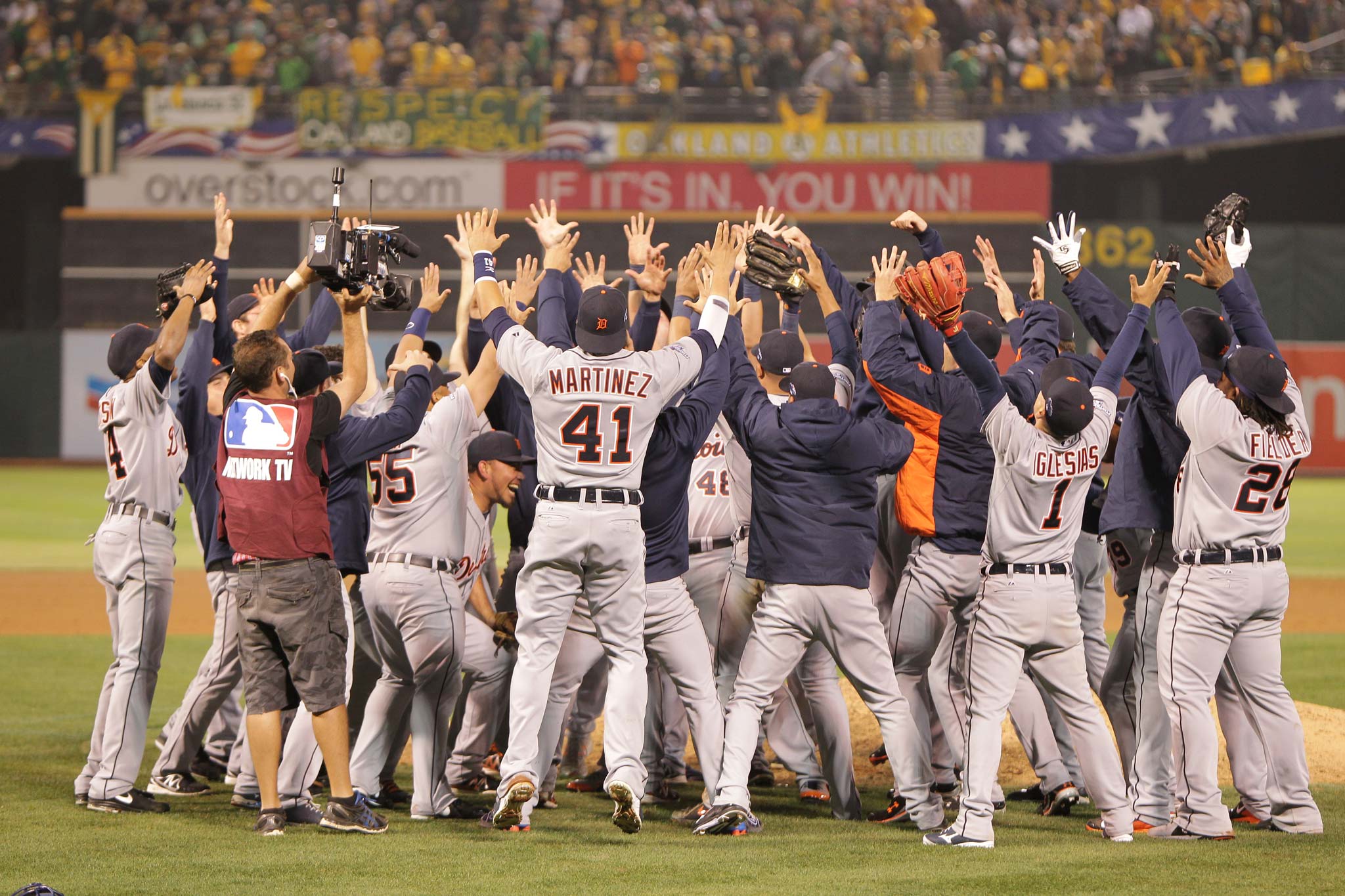
Moving on to the Red Sox series, it’s hard for me to imagine the Tigers losing the ALCS against Boston with home field advantage and Cabrera and Fielder at full strength, whether mentally or physically.  In the first three games of the series each of the Tigers’ starters took no-hitters into the fifth inning or beyond.  The Red Sox’ pitchers were just as good; the Tigers won Game 1 at Fenway 1-0, the Red Sox won Game 3 at CoPa by the same score.  Detroit’s bullpen had an infamous meltdown in Game 2 that may well have turned the tide of the series.  Cabrera, unable to drive the ball effectively, grounded into a rally-killing double play in Game 5.  Fielder belly flopped his way into a worse rally-killer in Game 6.  An uncharacteristic error by Iglesias followed by a grand slam by Shane Victorino and the Red Sox were off to their third World Series in a decade.

With Cabrera and Fielder playing healthy, there’s a good chance the 1-run games that went in the Red Sox’ favor go the other way.  With the Tigers playing 4 games at home, we don’t see the emotional explosion that came with David Ortiz’s 8th-inning grand slam in Game 2.  Do the Red Sox get a hit before there’s 1 out in the 9th of Game 1?  Possibly, and it’s possible that those hits lead to a run (Anibal Sanchez only pitched 6 innings despite having a no-hitter going), so perhaps Game 1 goes another way.  But in my heart of hearts, I believe that the Tigers win the ALCS with home field advantage.

That brings us to the World Series, which is admittedly harder to break down.  The Tigers didn’t play the Cardinals in 2013, and even if they had, we’ve routinely found that head-to-head matchups don’t mean anything when it comes to the postseason.  As an example, the Tigers went 8-4 against the Minnesota Twins in 1987, outscoring them by 25 runs; the Twins won the ALCS in 5 games.

But despite the fact that the Cardinals won the same number of games as the Red Sox in 2013, I believe the Tigers and Red Sox were the two best teams in the game.  The Tigers would’ve held home field advantage in the Series, and both their rotation and lineups were superior to the Cardinals.

Of course, the same could be said of the Tigers’ World Series teams in 2006 and 2012, and they won a combined total of 1 game in losing both of those series, scoring only 17 runs in those 9 games.  The big difference, however, was the layoff, or lack thereof.  The Tigers had won 7 consecutive games in the 2006 postseason before being forced to take a week off while they waited for the Cardinals to finish off the Mets in 7 games.  In 2012 a 6-day layoff after sweeping the Yankees in the ALCS killed any momentum.  Such a layoff wouldn’t have happened in 2013; regardless of how good the Tigers were, they were not going to sweep the Red Sox; the series likely goes at least 6 games, which would’ve resulted in a 3-day layoff.  That’s enough to get your pitchers lined up, but not so much that it turns your team rusty.

In conclusion, I declare that barring Garcia’s indiscretion, the Tigers would’ve won the 2013 World Series.

Thanks Avi.

C85I8353web

The Aftermath

The story doesn’t end there.  As every Tiger fan knows, Fielder didn’t exactly take the loss in the ALCS as hard as many would’ve liked him to.  When asked if the loss would linger, Fielder responded by saying, “Nah…I got kids, man. You gotta be a man about it. I got kids. If I’m sitting around pouting, how am I going to tell them to keep their chins up if something doesn’t go their way? Definitely, it’s over.”  That interview was played over and over on local radio, and Fielder being dealt out of town was simply a matter of time (and the amount of his contract Mike Ilitch was willing to cover).  A month later, Fielder was traded to Texas for Ian Kinsler.

But Fielder’s responses weren’t particularly ridiculous for a guy who had gone through what he had gone through.  Here was a guy who had to go to work every day and look at a teammate who had slept with his wife.  It’s entirely reasonable for someone to be more concerned about raising their kids properly during their parents’ divorce than work troubles, especially if their income is not at issue.

But without the affair/divorce and with a win in the World Series, those comments aren’t made and Fielder doesn’t lose face with the fans and the front office, and there’s no particular need to trade him.  His contract is still a massive albatross, but with his expected performance that’s a question for down the road as opposed to the 2013-14 offseason.  The team was concerned about cutting payroll, and the Fielder-Kinsler deal helped that, but with a World Series victory as opposed to an ALCS loss, the Tigers bring in additional money in World Series ticket sales; additional merchandise and memorabilia sales; and a likely increase in ticket sales in 2014 (as opposed to a 5% attendance decrease).  Simply put, Fielder isn’t traded after the 2013 season.

This creates a domino effect for the Tigers’ postseason plans.  Without the trade, Fielder stays at first and Cabrera at third, which either delays Nick Castellanos’s ascension to the team, or he stays in the outfield as he had been playing in the minors.  I suspect they keep him in the minors, as the Tigers had signed Rajai Davis to serve as their left fielder.  They could have brought Castellanos up to the Majors and had Davis serve as their 4th outfielder, but Castellanos still likely needed the seasoning, both at the plate and in the outfield.

Without Kinsler being acquired, the Tigers focus on signing a second baseman.  Omar Infante ultimately signed with the Royals for 4 years and just over $30 million.  I suspect without the Fielder issues this would’ve been an easy call to re-sign him.

The big question is what becomes of the Doug Fister trade.  A few short weeks after the Fielder trade, Fister was traded for Robbie Ray, Ian Krol and Steve Lombardozzi.  A lot of fans – myself included – consider this to be the worst trade of the Dave Dombrowski era, a fact compounded by the fact that he traded Ray (the supposed centerpiece of the Tigers’ haul) just before he realized his promise for human dumpster fire Shane Greene.

The Fister trade was deemed to be a salary cutting move.  This could be true, but Fister was under team control for 2014 and 2015 and was only awarded $7.2 million in arbitration going for the 2014 season.  When you add in the financial impact of the Fielder trade on a yearly basis, trading he and Fister saved the Tigers just over $15 million.  Without the Fielder deal, the Fister trade might seem a bit less likely, especially if the Tigers are going to cite cutting payroll as an excuse.

My feeling is that a couple of trade scenarios occur if Fielder isn’t traded.  One is that, in an effort to cut payroll in one fell swoop, they deal Max Scherzer, who has only one year left with the team, was awarded $15.25 million in arbitration, and would turn down a 6-year, $144 million contract during that offseason (a decision which supposedly doomed any chances of him coming back to the team).  Scherzer may have brought a heavy haul, but his pending free agency likely caused any deal to be difficult.

The second is to trade some combination of Rick Porcello, Drew Smyly, Austin Jackson and Nick Castellanos.  Porcello would ultimately be dealt for Yoenis Cespedes with one year left on his contract (to be fair, this was a need-for-need trade, as Cespedes also only had one year left on his deal).  Smyly and Jackson (along with a prospect) ultimately brought the Tigers David Price at the 2014 trade deadline, so they had value.  Smyly was a converted starter who excelled as a reliever in 2013 because there was no room for him in the rotation.  Fister was likely traded because it was believed that it was his turn to slide into the rotation.  If true, I find it to be a mistake on the part of the Tigers, as Detroit had Smyly under team control for 5 years, he was excellent in the bullpen and the team was likely to lose one of their starters when Scherzer departed after the 2014 season, opening a spot for Smyly with plenty of time to make a name for himself as a starter before he entered his prime earning years.

The third option is to stand pat.  The Tigers paid $173 million in salary in 2014, ranking them 4th in the Majors, and keeping Fielder and Fister would’ve brought that payroll up to almost $190 million, so there would’ve been problems doing so.  But keeping a World Series champion team in tact knowing that the staff ace was likely to leave after the 2014 season isn’t a ridiculous notion, no matter the payroll impact.

Which of these things happen?  I honestly don’t know.  Nobody does, quite frankly, and choosing a given route leads one down an even greater What If investigation.  And it doesn’t consider even more issues, like what do the Tigers do when they lose Iglesias, Fielder and Bruce Rondon to season-ending injuries in 2014.  But we do know that one bad decision can create irreparable harm to a championship caliber team.

I don’t know that the ultimate outcome of the drama with the 2013 Tigers was the worst outcome of the countless circumstances where a player slept with one of his teammates’ wives/girlfriends.  But it does make you wonder why, when there are innumerable jersey chasers out there, a guy would choose to create such clubhouse drama by choosing his teammate’s wife.

Thanks Avi.

*All WAR numbers courtesy of baseball-reference.com.