The Detroit Sports Czar’s Viewing Guide to the Coronavirus Shutdown

Folks, it’s been a while.  But we are living in bizarre times, with all sports shut down for the first time since 9/11, and the Detroit Sports Czar is here to fill the desperate sports viewer’s void.

Detroit’s had plenty of rewatchable sporting events over the last few decades, and with the leagues opening up their League Pass apps for free during the shutdowns or offering games on YouTube, now is the perfect time to catch up on some classic games to give you yours sports fix.

Without further ado, I present you with the DSC’s Viewing Guide to the Coronavirus Shutdown.

(Some of these may require you to sign up for free access to Leagues’ Game Pass websites, but otherwise these are games that you can access for free.)
Screen Shot 2020-03-24 at 10.43.47 PM

Detroit Tigers

Tigers 4, Yankees 3 (2006 ALDS Game 2)

We’re kicking things off with a couple of dark horses.  The Tigers have had plenty of rewatchable games over the years.  We could go back to 1984 and show you Game 5 of that year’s World Series.  Or Game 162 in 1987.  Or Justin Verlander’s no-hitters, the Armando Galarraga perfect game, or the Magglio Ordonez pennant-clinching home run.  You could even go with 2009’s Game 163 if you hate yourself (a truly classic game, but not exactly one that Tigers fans would be too eager to re-live).  But we’re going with a game that quite possibly changed the history of the Tigers’ franchise.

In 2006 the Tigers took the baseball world by storm, jumping out to a huge lead in the AL Central before a late-season collapse landed them the Wild Card spot and a Division Series matchup with the New York Yankees, owners of the best record in baseball (although only 2 games in front of the Tigers), spoiling some of the excitement of their first playoff birth in 19 years.  After their late season swoon and a Game 1 loss at Yankee Stadium (which followed some rain delay shenanigans on the part of the home team), most Tigers fans were hoping only to escape that season’s playoffs without getting swept.

That pessimism felt justified after a Johnny Damon home run in the 4th gave the Yankees a 3-1 lead.  But the Tigers clawed back, cutting the lead in half on a Curtis Granderson sac fly in the 5th and tying it up on a Carlos Guillen home run in the 6th.  When Granderson tripled in Marcus Thames in the 7th to give the Tigers the lead, Detroit went wild, realizing the Tigers could win the series without going back to New York.  They did just that, finishing off the victory in Game 2, kicking off a 7-game winning streak that would only be stopped by a 9-day layoff before the World Series.

If the Tigers don’t win Game 2, a sweep is not out of the question, and it’s questionable how much of that season turns out to be a fluke.  Owner Mike Ilitch was a spender in those days, so it’s likely his moves don’t change much in the ensuing offseasons, but there’s no question Game 2 helped put the Tigers back on the baseball map.

Detroit Lions

Lions 38, Browns 37 (2009)

Look, finding a rewatchable game for Lions fans isn’t easy.  Their last playoff win was 28 years ago, and that’s their only one since they finished their run as the Team of the ’50s in 1957.  Any memorable game the Lions have been involved in found them on the losing end, and we don’t want to spend our quarantine being any more miserable than we have to be.  The best bet here would be to just share a highlight reel of Barry Sanders runs, and hell, why not just to be safe.

But in 2009 they won a game that a YouTube video proclaims to be “The Greatest Game That Nobody Watched”, and having been at the game, it’s hard to disagree.  Usually I wouldn’t guide you to a game between two 1-8 teams, but it’s one worth watching.  The Browns jumped out to a 24-3 first quarter lead, only to watch the Lions tie it in the 2nd.  The Lions got the ball back down 6 with no timeouts and under two minutes to go, and rookie Matthew Stafford led the team to the Cleveland 32 with 8 seconds left.  Then things got weird.

Stafford scrambled the remaining 8 seconds (plus an additional 4, just for good measure) off the clock, threw an interception in the end zone, and absorbed a vicious blow that dislocated his non-throwing shoulder.  Game over, right?  Nope.  The Browns got flagged for pass interference in the end zone, nullifying the interception and granting the Lions an untimed down (those don’t typically turn out too well for the Lions).  Stafford had to come out of the game because of the injury, but after the Lions were (correctly) granted an injury timeout, Browns coach Eric Mangini called a timeout of his own to throw a temper tantrum, the Lions were able to put Stafford back in the game even with the injured shoulder, and he threw a touchdown pass to fellow first round rookie Brandon Pettigrew, allowing the Jason Hanson kick to win the game with no time left.

Truly a classic that hardly anyone ever talks about.  Most of the classics we talk about come in the playoffs or between contenders, but sometimes the best games come between two bad teams on a random November Sunday.

Detroit Pistons

“The Block”

The Pistons have played plenty of classics over the years, but a fair chunk of them, like the Lions, saw them coming out on the losing end.  The last 2 games of the 1988 NBA Finals were undoubtedly great, but the Pistons got the short end in both (both literally and figuratively, as the officiating was…less than top notch).  There was Isiah Thomas scoring 16 points in 94 seconds to send a clinching playoff game to OT, but again the Pistons came up short.

So we’ll go with “The Block” in Game 2 of the 2004 Eastern Conference Finals.  Down 1-0 to the Pacers, the Pistons clung to a 2-point lead in Indianapolis when they turned the ball over with 23 seconds left in the game.  Indiana picked up the loose ball and Jamal Tinsley found a streaking Reggie Miller racing towards the basket.  But instead of an apparent easy layup for Miller, Tayshaun Prince came out of nowhere to block the shot, with Rip Hamilton corralling the ball rather than setting up an inbounds play for the Pacers.  The Pistons would win the game, take 3 of the next 4 to win the series, then score one of the biggest upsets in NBA history when they pulled off the “5-Game Sweep” of the heavily favored Lakers.

While the shot only kept the Pacers from tying the game and there’s no guarantee they win, if the Pacers win that series they take a 2-0 lead and are heavily favored to win the series.  A win against the Lakers was not guaranteed but also not unlikely.  The Pacers were among the NBA’s contenders in the 2004-05 season, derailed only by the Malice at the Palace.  But with a possible title under their belt, it’s reasonable to think that the brawl never happens, Indiana isn’t depleted, and the Pacers and not the Pistons spend the next few seasons going to the Eastern Conference finals (if not further).

(The NBA has opened up their League Pass site during the shutdown, but the classic games are shockingly sparse, so I had to find video of this play on YouTube.  Sorry I couldn’t do better.)

Detroit Red Wings

“The Brawl”

I tried to keep to recent history with these teams, but the Red Wings’ recent history has been…less than ideal, shall we say.  So we’re going back to the game that really started the Red Wings dynasty.

The Wings had really become contenders in the late-’80s/early-’90s after years of being known as the Dead Things in Detroit, but by 1997 they’d become the Buffalo Bills of the NHL, failing to live up to their potential in some memorable playoff flameouts.  By 1997 it was thought that their window had closed and passed on to others, with the Avalanche winning the Cup in 1996 in their first season in Denver.

Colorado – and Claude Lemieux specifically – had kicked off the rivalry when Lemieux checked Kris Draper into the dasher, breaking his jaw, nose, and cheekbone, and giving him a concussion, in Game 6 of the prior season’s Western Conference Finals.  Lemieux was ejected from the game, but the Avalanche would win the game and the series, and go on to win the Stanley Cup against the Panthers.  The hit was not forgotten, and when things got chippy in a late-season game in Detroit, all hell broke loose.

The game had seen a couple of fights, but the real fireworks started when Igor Larionov and Peter Forsberg (not exactly well-known brawlers) went at it late in the 1st period.  It wasn’t long before Darren McCarty made Lemieux answer for the Draper hit, sending him to the ice in a turtle position while throwing shots relentlessly.  Patrick Roy left the goalie crease to help his teammate, leading to a memorable collision between he and Brendan Shanahan and eventually the rare goalie brawl between Roy and Mike Vernon.  At the end of the game the teams had racked up 144 penalty minutes.

Thing is, the Avalanche had the Wings’ number, having won the all 3 games up to that point between the two teams, so the brawl meant nothing if the Wings couldn’t get the win.  Luckily, McCarty was able to play the hero in more ways than one, netting the game winner in OT.  The game propelled the Wings into the playoffs and another matchup with Colorado, with the Wings winning the conference finals in 6 games (blowing out the Avalanche 6-0 in another brawl-filled Game 4).  The Wings would sweep Philadelphia in the Stanley Cup Final, with McCarty scoring the Cup-clinching goal, ending a 42-year title drought for the Red Wg ings.

(Another video not available on YouTube, but some pretty good footage of the fights in the March 26 game.)

Michigan State Football

“Trouble with The Snap!”

Our college teams give us a much lengthier list of memorable games to choose from, and we’ll start with Michigan State football.  Do we go with “Little Giants”, with Mark Dantonio calling one of the gutsiest play fakes in history with the overtime touchdown pass by his punter?  Or the Hail Mary against Wisconsin in 2011?  Perhaps you like the Northwestern comeback in 2006?  The 2014 Rose Bowl?  Negative 48 yards rushing by the defense against Michigan in 2013?  Or the Ohio State game or Big 10 championship games in 2015?

But no, this one’s simple.  It’s the 2015 Michigan-Michigan State game.  The Spartans had won the game everywhere except where it mattered, beating the Wolverines soundly in both first (20-10) and total yards (386-230).  MSU had cut it to two with just under 9 minutes left in the game, but a late attempt to get into field goal range had failed with 1:47 left on the clock.  Michigan State had a timeout left and was able to force a punt with 10 seconds left, but all Michigan had to do was get the kick off and the game was over.

Except, they couldn’t pull it off.  Punter Blake O’Neill bobbled a low snap, the ball popped free as he was trying to get the kick off, right into the hands of Jalen Watts-Jackson, who ran it back 38 yards to win the game as time expired.  Michigan State stayed undefeated, would go on to beat Ohio State with their backup quarterback, survive a late loss at Nebraska, and win the Big 10 championship game to clinch a spot in the College Football Playoff against Alabama.

(We won’t talk about what happened there.)

Michigan State Basketball

Michigan State 68, Duke 67 (2019 NCAA Regional Final)

This was a tough one.  When you’ve got games where your school won a national title, it seems logical to go that route.  Parades are forever after all, and the 1979 championship game remains iconic.  But there’s just something about beating Duke…even if it doesn’t happen all that often.

Michigan State enters most NCAA tournaments contending for the title, and 8 Final Fours in the last 21 seasons backs up that resume (even if their Final Four results have been less than stellar).  But Duke was the favorite last season, with the top 3 in the ESPN 100 starting (plus #17 and #41 for good measure).  MSU fans groaned when they saw Duke on the top line of their bracket, but stranger things had happened.  The tables looked like they might have turned, as MSU had won their first 3 games by an average of 16, while Duke had survived their 2nd and 3rd round games by a total of 3 points.

The game was close throughout, with the Spartans managing to turn a 9-point first half deficit into a 4-point halftime lead.  The second half was a nail-biter, with the game separated by no more than 6 points.  Duke held a 1-point lead with 50 seconds left, when Kenny Goins was able to pull down the rebound on an R.J. Barrett jumper, then hit the go-ahead 3 with 34 seconds left.  Duke had their chances, with Barrett going to the line with a chance to tie with 5 seconds left.  He missed the first, then hit the second when he was trying to miss and force the rebound.  Michigan State was able to inbound, Duke didn’t have enough fouls to send MSU to the line, and the Spartans were off to Minneapolis.

(We won’t talk about what happened there either.)

Bonus: 2000 One Shining Moment

Now, my faithful readers will know that the Detroit Sports Czar is a devout Spartan, but as I said at the outset, we’re in bizarre times, and I’m not above showing solidarity with my readers who may be faithful to Michigan.  I’m not going to give you a write-up for these games, but there’s some entertainment to be had for the Wolverines out there.

Michigan Football

The Braylon Edwards Game

I know the “Trouble with the Snap” game is painful for Michigan fans, so I’ll give you one that was just as painful to us.  MSU blows a 27-10 lead, Braylon Edwards catches 3 TD, and Michigan wins the first overtime game in the rivalry’s history.

Michigan Basketball

Michigan 87, Kansas 85 in OT (2013 NCAA Regional Semifinal)

I could’ve gone with the 1989 NCAA title game, but I’m trying to keep it relatively recent.  Michigan rallies back from 14 down with 7 minutes left, then Trey Burke hits a 30-footer with 4 seconds left to send the game to overtime.  They knock off top-seeded Kansas and advance to the school’s first title game in 20 years.  Wait…make that 24.

(Had to.)

Bonus: 1989 One Shining Moment

Things have been bad on the Detroit sports scene in recent years.  The city’s last playoff win was five and a half years ago, our college teams have not lived up to expectations, and only the Pistons were not in last place at the time the world closed (and they were only half a game up on the Cavaliers).  But this town loves our sports, and we were just as sad to watch the games end as people in Boston, or Milwaukee, or Dayton (ok, maybe not Milwaukee or Dayton, as they’d had legit title teams shut down).  If watching these games can bring just a little happiness to your world in these dark times, I’ll consider that a win.
What If: 2013 Detroit Tigers

Baseball history is filled with all sorts of “What Ifs”?  What if Fred Merkle touches second base?  What if the Red Sox never sell Babe Ruth?  What if Johnny Pesky doesn’t hold the ball?  What if Bill Buckner makes the play?  What if Chuck Knoblauch doesn’t fake out Lonnie Smith?  What if Grady Little pulls Pedro Martinez?

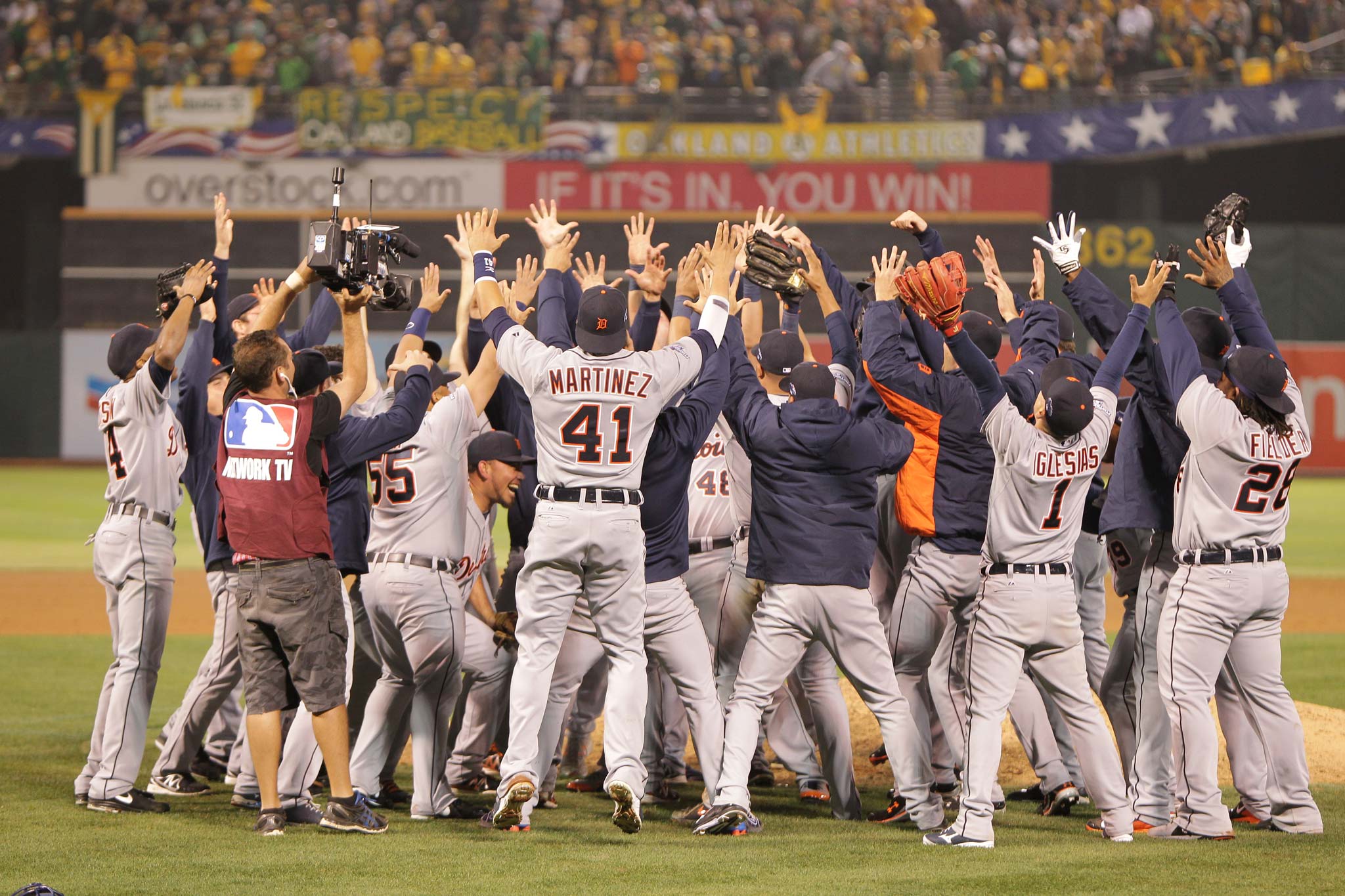
And in 2013, the Detroit Tigers had their very own “What If” alter the course of their season and in fact the future of the franchise, not to mention preventing the occurrence of something that had never happened in Major League history

What if Avi Garcia never fucked Prince Fielder’s wife?

It’s a thinly veiled rumor that has been all but confirmed in the local press without ever being reported, because in the grand scheme of things, such a betrayal by a teammate can’t be reported by the media without hard core proof.  When it’s happened in the past (LeBron James’s mom and Delonte West, the Jimmy Jackson/Jason Kidd/Toni Braxton love triangle, etc.), the stories have been left for sites like Deadspin to pick up, as opposed to being discussed by the local beat writers.  But this one is as confirmed as could possibly be imagined in today’s day and age.

An additional rumor posits that a fight between Miguel Cabrera and Garcia caused the groin/core injury that derailed Cabrera’s run at an unprecedented second consecutive Triple Crown.  I looked at the rosters and where and when Cabrera would’ve been in the same place as Garcia before he was traded away and found it to be impossible, but looking at it from another angle caused me to change my view.

The 2013 Tigers were probably the best team of their recent run, even though they failed to make the World Series.  If there’s any season that a rational Tiger fan could look at and wonder what might have been, it was that one.  So I’ll break down some of the variables and see what could have changed.

Prince Fielder’s Season

Let’s look at Fielder’s history.  In 2011 with Milwaukee and 2012 with the Tigers, he had put up offensive WAR* numbers of 5.5 and 5.3, respectively.  He finished in the top 10 in the MVP voting both years (in both seasons the guy he was protecting in the batting order won the award, meaning that Fielder likely had some votes poached from him).  In 2013, with no known injury issues, that number slipped to 3.1.  What happened?

In August of that year, Torii Hunter made remarks during a radio interview indicating that Fielder was dealing with a personal issue, leading to his struggles at the plate.  Fielder responded to the comments by saying that his personal life would stay personal, but reporters being reporters, this wasn’t going to die.  Two days later, it was reported that Fielder had filed for divorce at the end of May.

It would be easy to suspect that the affair between Fielder’s wife and Garcia had occurred sometime before that date, although it’s not known when.  At that point in the season, Fielder was hitting .273/.397/.487, and he was on pace for 30 HR and 137 RBI.  He raised his average over the course of the season, but his power and OBP numbers slipped somewhat.  Nevertheless, this wasn’t the season people expected out of Fielder, especially with Victor Martinez back in the lineup providing protection.  He was borderline atrocious in the postseason, wracking up only 10 total bases and 3 walks with no RBI in 45 plate appearances, and making some terrible plays on the basepaths that took the Tigers out of badly-needed rallies.

Something happened that caused Fielder’s dropoff, and there’s no injury to explain it.

Miguel Cabrera’s Injury

In 2012, Miguel Cabrera won the first Triple Crown in baseball in 45 years, despite putting up offensive WAR numbers that were lower than both his prior and subsequent seasons.  In 2013 Cabrera had the best offensive season of his career, despite missing 14 games to a nagging groin injury.  The rumored fight between Cabrera and Garcia seems impossible on its surface.  Garcia was sent to the minors in July and was traded to the White Sox at the deadline, and Cabrera’s performance didn’t start to lag until mid-August, so it would seem that the fight was a myth.

But another look suggests that may not be the case.  Garcia was traded to the White Sox on July 30 and shortly thereafter became an everyday outfielder for Chicago.  The White Sox played a 3-game series against the Tigers in Chicago from August 12-14.  At the start of that series, Cabrera was hitting .365/.459/.686 and was on pace for 54 home runs and 166 RBI, numbers that would’ve easily won him the Triple Crown again.  Beginning with that series, his numbers fell to .299/.392/.493 over the remainder of the season, and he only hit 8 more home runs and drove in 27 runs for the rest of the year (on a full-season basis that projects out to 33 HR and 110 RBI).  Cabrera had gone from an historically epic season to a merely good slugger.  What happened?

Sure, you can argue that Cabrera suffered an injury on the field, but considering how prevalent the rumor of this supposed fight is, let’s have some fun and imagine it happened.

Garcia/Iglesias Trade

Garcia was traded as part of a three-way deal that brought shortstop Jose Iglesias from Boston to Detroit and sent Garcia to the White Sox.  While I’m sure that the affair was a consideration in making the deal, it wasn’t the only one.  Jhonny Peralta had recently been suspended for using PED’s and would be a free agent after the season, and with Garcia unable to crack the lineup in the minors, the Tigers probably make the deal, whether or not Garcia could keep it in his pants.

In the list of What Ifs, this one doesn’t compute.  Garcia is still traded for Iglesias.

Impact on 2013 Season

Let’s get Cabrera’s feat out of the way.  The injury probably cost Cabrera a second consecutive Triple Crown, which had never happened before.  As we showed before, Cabrera was hitting .365 going into the White Sox series and was on pace for 54 HR and 166 RBI.  He ultimately led Major League Baseball with a .348 average (not to mention the slash line Triple Crown, going .348/.442/.636, and leading the Majors in OPS at 1.078), but he fell short on HR and RBI, finishing second in both categories.  It’s reasonable to expect his numbers would’ve fallen off, but you could also conclude that he might’ve played a few extra games (he missed 6 after August 12) over the remainder of the season to try to capture another Crown if he hadn’t been hurt.  My conclusion is that without the injury, Cabrera becomes the first player to win back-to-back Triple Crowns.

Looking at the Tigers’ postseason seeding, one could come to the conclusion that an injured Cabrera and depressed Fielder didn’t make a difference.  But look again.  Doing an admittedly rough estimation of Cabrera’s offensive WAR through the beginning of the White Sox series and projecting it to the remainder of the year adds roughly 1.3 offensive wins to his number.  And if Fielder stays as productive as he did the previous two seasons, one could expect an offensive WAR of roughly 5.4 instead of 3.1, an increase of 2.3 wins.  Combine those two numbers and you add an additional 3-4 wins to the Tigers’ 2013 total.  The Tigers finished 4 games behind the Red Sox (and 3 behind the A’s) for the best record in the American League – and thus home field advantage in the playoffs – despite effectively waiving the white flag going into a season-ending series against the Marlins, where they were swept.  If the Tigers get the additional 3-4 wins from Cabrera and Fielder, they don’t take those games off, and likely win the necessary games to capture home field advantage in the playoffs.

And just for good measure, they probably aren’t no-hit in the season finale.

Now we look at the playoffs.  The Tigers defeated the A’s in 5 games in the ALDS.  I won’t examine this series any further and I’ll just assume that the Tigers win it (as they have every postseason series they’ve played against Oakland since Bert Campaneris tried to murder Lerrin LaGrow in 1972).

Moving on to the Red Sox series, it’s hard for me to imagine the Tigers losing the ALCS against Boston with home field advantage and Cabrera and Fielder at full strength, whether mentally or physically.  In the first three games of the series each of the Tigers’ starters took no-hitters into the fifth inning or beyond.  The Red Sox’ pitchers were just as good; the Tigers won Game 1 at Fenway 1-0, the Red Sox won Game 3 at CoPa by the same score.  Detroit’s bullpen had an infamous meltdown in Game 2 that may well have turned the tide of the series.  Cabrera, unable to drive the ball effectively, grounded into a rally-killing double play in Game 5.  Fielder belly flopped his way into a worse rally-killer in Game 6.  An uncharacteristic error by Iglesias followed by a grand slam by Shane Victorino and the Red Sox were off to their third World Series in a decade.

With Cabrera and Fielder playing healthy, there’s a good chance the 1-run games that went in the Red Sox’ favor go the other way.  With the Tigers playing 4 games at home, we don’t see the emotional explosion that came with David Ortiz’s 8th-inning grand slam in Game 2.  Do the Red Sox get a hit before there’s 1 out in the 9th of Game 1?  Possibly, and it’s possible that those hits lead to a run (Anibal Sanchez only pitched 6 innings despite having a no-hitter going), so perhaps Game 1 goes another way.  But in my heart of hearts, I believe that the Tigers win the ALCS with home field advantage.

That brings us to the World Series, which is admittedly harder to break down.  The Tigers didn’t play the Cardinals in 2013, and even if they had, we’ve routinely found that head-to-head matchups don’t mean anything when it comes to the postseason.  As an example, the Tigers went 8-4 against the Minnesota Twins in 1987, outscoring them by 25 runs; the Twins won the ALCS in 5 games.

But despite the fact that the Cardinals won the same number of games as the Red Sox in 2013, I believe the Tigers and Red Sox were the two best teams in the game.  The Tigers would’ve held home field advantage in the Series, and both their rotation and lineups were superior to the Cardinals.

Of course, the same could be said of the Tigers’ World Series teams in 2006 and 2012, and they won a combined total of 1 game in losing both of those series, scoring only 17 runs in those 9 games.  The big difference, however, was the layoff, or lack thereof.  The Tigers had won 7 consecutive games in the 2006 postseason before being forced to take a week off while they waited for the Cardinals to finish off the Mets in 7 games.  In 2012 a 6-day layoff after sweeping the Yankees in the ALCS killed any momentum.  Such a layoff wouldn’t have happened in 2013; regardless of how good the Tigers were, they were not going to sweep the Red Sox; the series likely goes at least 6 games, which would’ve resulted in a 3-day layoff.  That’s enough to get your pitchers lined up, but not so much that it turns your team rusty.

In conclusion, I declare that barring Garcia’s indiscretion, the Tigers would’ve won the 2013 World Series.

Thanks Avi.

C85I8353web

The Aftermath

The story doesn’t end there.  As every Tiger fan knows, Fielder didn’t exactly take the loss in the ALCS as hard as many would’ve liked him to.  When asked if the loss would linger, Fielder responded by saying, “Nah…I got kids, man. You gotta be a man about it. I got kids. If I’m sitting around pouting, how am I going to tell them to keep their chins up if something doesn’t go their way? Definitely, it’s over.”  That interview was played over and over on local radio, and Fielder being dealt out of town was simply a matter of time (and the amount of his contract Mike Ilitch was willing to cover).  A month later, Fielder was traded to Texas for Ian Kinsler.

But Fielder’s responses weren’t particularly ridiculous for a guy who had gone through what he had gone through.  Here was a guy who had to go to work every day and look at a teammate who had slept with his wife.  It’s entirely reasonable for someone to be more concerned about raising their kids properly during their parents’ divorce than work troubles, especially if their income is not at issue.

But without the affair/divorce and with a win in the World Series, those comments aren’t made and Fielder doesn’t lose face with the fans and the front office, and there’s no particular need to trade him.  His contract is still a massive albatross, but with his expected performance that’s a question for down the road as opposed to the 2013-14 offseason.  The team was concerned about cutting payroll, and the Fielder-Kinsler deal helped that, but with a World Series victory as opposed to an ALCS loss, the Tigers bring in additional money in World Series ticket sales; additional merchandise and memorabilia sales; and a likely increase in ticket sales in 2014 (as opposed to a 5% attendance decrease).  Simply put, Fielder isn’t traded after the 2013 season.

This creates a domino effect for the Tigers’ postseason plans.  Without the trade, Fielder stays at first and Cabrera at third, which either delays Nick Castellanos’s ascension to the team, or he stays in the outfield as he had been playing in the minors.  I suspect they keep him in the minors, as the Tigers had signed Rajai Davis to serve as their left fielder.  They could have brought Castellanos up to the Majors and had Davis serve as their 4th outfielder, but Castellanos still likely needed the seasoning, both at the plate and in the outfield.

Without Kinsler being acquired, the Tigers focus on signing a second baseman.  Omar Infante ultimately signed with the Royals for 4 years and just over $30 million.  I suspect without the Fielder issues this would’ve been an easy call to re-sign him.

The big question is what becomes of the Doug Fister trade.  A few short weeks after the Fielder trade, Fister was traded for Robbie Ray, Ian Krol and Steve Lombardozzi.  A lot of fans – myself included – consider this to be the worst trade of the Dave Dombrowski era, a fact compounded by the fact that he traded Ray (the supposed centerpiece of the Tigers’ haul) just before he realized his promise for human dumpster fire Shane Greene.

The Fister trade was deemed to be a salary cutting move.  This could be true, but Fister was under team control for 2014 and 2015 and was only awarded $7.2 million in arbitration going for the 2014 season.  When you add in the financial impact of the Fielder trade on a yearly basis, trading he and Fister saved the Tigers just over $15 million.  Without the Fielder deal, the Fister trade might seem a bit less likely, especially if the Tigers are going to cite cutting payroll as an excuse.

My feeling is that a couple of trade scenarios occur if Fielder isn’t traded.  One is that, in an effort to cut payroll in one fell swoop, they deal Max Scherzer, who has only one year left with the team, was awarded $15.25 million in arbitration, and would turn down a 6-year, $144 million contract during that offseason (a decision which supposedly doomed any chances of him coming back to the team).  Scherzer may have brought a heavy haul, but his pending free agency likely caused any deal to be difficult.

The second is to trade some combination of Rick Porcello, Drew Smyly, Austin Jackson and Nick Castellanos.  Porcello would ultimately be dealt for Yoenis Cespedes with one year left on his contract (to be fair, this was a need-for-need trade, as Cespedes also only had one year left on his deal).  Smyly and Jackson (along with a prospect) ultimately brought the Tigers David Price at the 2014 trade deadline, so they had value.  Smyly was a converted starter who excelled as a reliever in 2013 because there was no room for him in the rotation.  Fister was likely traded because it was believed that it was his turn to slide into the rotation.  If true, I find it to be a mistake on the part of the Tigers, as Detroit had Smyly under team control for 5 years, he was excellent in the bullpen and the team was likely to lose one of their starters when Scherzer departed after the 2014 season, opening a spot for Smyly with plenty of time to make a name for himself as a starter before he entered his prime earning years.

The third option is to stand pat.  The Tigers paid $173 million in salary in 2014, ranking them 4th in the Majors, and keeping Fielder and Fister would’ve brought that payroll up to almost $190 million, so there would’ve been problems doing so.  But keeping a World Series champion team in tact knowing that the staff ace was likely to leave after the 2014 season isn’t a ridiculous notion, no matter the payroll impact.

Which of these things happen?  I honestly don’t know.  Nobody does, quite frankly, and choosing a given route leads one down an even greater What If investigation.  And it doesn’t consider even more issues, like what do the Tigers do when they lose Iglesias, Fielder and Bruce Rondon to season-ending injuries in 2014.  But we do know that one bad decision can create irreparable harm to a championship caliber team.

I don’t know that the ultimate outcome of the drama with the 2013 Tigers was the worst outcome of the countless circumstances where a player slept with one of his teammates’ wives/girlfriends.  But it does make you wonder why, when there are innumerable jersey chasers out there, a guy would choose to create such clubhouse drama by choosing his teammate’s wife.

Thanks Avi.

*All WAR numbers courtesy of baseball-reference.com.

On Karma and Mike Ilitch

(Before I begin, it’s important to point out that I worked for the Ilitch family for five years.  None of what I write below has anything to do with my employment with the organization.  I left of my own free will.  This observation is based solely on my sports fandom and interest in the city as a whole.)

Sports Illustrated recently ran a story about spring training in 1995.  Included in that story was a tale about Sparky Anderson taking a stand and essentially ending his managerial career.  In his autobiography he called it his proudest moment.  In taking that stand he began to expose a little-known fact about one of the most beloved individuals in Detroit sports.

Mike Ilitch is kind of a dick.

Let’s start with a little history lesson.

In 1994, MLB owners decided that the finances of the game didn’t work for them.  Less than four years after being assessed damages of $280 million for colluding against free agents, the owners unilaterally decided that they would implement a salary cap.  The players balked – naturally, because salary caps are stupid – so the owners responded by refusing to pay a required $7.8 million to the players’ pension and benefit plan.  The players responded by going on strike, eventually leading to the cancellation of the 1994 World Series.

Early in 1995 the owners abandoned their salary cap plans; announced they would use replacement players (more on that shortly); abolished salary arbitration; centralized player negotiations with the commissioner’s office – which is bothersome on a number of levels that we won’t get into here; and ended an agreement not to collude on salaries.  The players filed an unfair labor practices complaint with the National Labor Relations Board.  Future Supreme Court Justice Sonia Sotmayor issued an injunction against the owners, the old agreement was put back in place, and the players returned to work.  An agreement was eventually reached in November 1996 and baseball hasn’t seen a work stoppage since.

Now back to those replacement players…

The owners announced in January that they would use replacement players for the 1995 season.  Apparently they were dumb enough to think fans were just as willing to pay to watch Kevin Millar, Pete Rose Jr. and a 48-year-old Pedro Borbon play as they were to watch Barry Bonds, Ken Griffey Jr. and Greg Maddux.  There were a few interesting side notes to the replacement player ordeal.  The Baltimore Orioles decided they wouldn’t use replacement players.  Depending on whom you ask, this was because Peter Angelos made the bulk of his money representing Baltimore labor unions and their members.  Realistically, however, it was probably because the use of replacement players would end Cal Ripken Jr.’s run at Lou Gehrig’s consecutive games streak and cost the team a significant chunk of money in ticket sales and merchandising.

The Toronto Blue Jays announced they would play their home games at their spring training facility in Dunedin, Florida, because Canadian law prohibited companies from using replacement workers during a strike or lockout.  That they were willing to play their games at a minor league stadium probably says something about their expected attendance numbers with the replacement players.

And Sparky Anderson decided he wouldn’t manage the scabs.

Tigers’ owner Mike Ilitch was livid, placing Sparky on unpaid leave.  To be fair, this was a somewhat charitable move by the team considering Ilitch wanted to fire Sparky on the spot.  After the season Sparky left the team, never to manage in the Majors again, despite the fact that he was still interested in managing and was only 61 years old.

In 2000 Sparky was elected to the Baseball Hall of Fame.  When deciding what hat to wear on his plaque, he chose the Cincinnati Reds, a team he had managed half as long as he had managed the Tigers and also a team that had fired him (say whatever you want about the Tigers, they never officially fired him).  People in Detroit were not happy.  The Tigers held a “Sparky Anderson Day” in 2000, though they didn’t retire his number (no one ever wore #11 after Sparky).

In 2009, the Tigers held a 25th anniversary of their last World Series championship.  Sparky appeared frail; it would be his last appearance in Detroit.  If the Tigers were going to retire his number, it would’ve been the perfect time.  They didn’t.

Sparky died in November 2010.  The Tigers retired his number in 2011.  I find it to be no small coincidence that Sparky’s number wasn’t retired until after he passed away.

And for that I blame Mike Ilitch.

I don’t think Sparky should’ve had his number retired.  But if they were going to retire his number, there was absolutely no reason not to do it when he was still alive.

I’ll explain.

Years back, very early in my love affair with baseball, I heard a tale that the Tigers did not retire numbers for the majority of their history because Ty Cobb was their best player, and he didn’t wear a number that could be retired.  That lasted until 1980, when Al Kaline’s #6 was retired shortly after his enshrinement in the Hall of Fame.  In 1983, Charlie Gehringer and Hank Greenberg had their numbers retired, with Hal Newhouser following in 1997.  Up until that time, the only Tigers who had had their numbers retired were not only Hall of Famers, but they went into the Hall of Fame as Tigers.

Willie Horton’s number was retired in 2000.  Bluntly, it was an affirmative action retirement.  It was believed that a city with a population that was over 80% black and a history of race issues should have a black player with his number retired.  Horton was a bad choice – among black players in Tigers’ history Lou Whitaker would’ve been the better choice – but he was a good enough player, he was a key member of the 1968 world champions, he was from Detroit and he supposedly walked through the Detroit riots in 1967 in his uniform trying to quell the violence.

(Incidentally, Ilitch once “unretired” the number of Larry Aurie with the Red Wings.  Save for a short time when Aurie’s cousin wore his #6 with the Wings in the 1950’s, no one has worn the number again, but Aurie is not honored with a banner in the rafters as the other Red Wings’ retired numbers are.)

Still, I’ve always lived with the notion that in order to have your number retired by the Tigers you had to go into the Hall of Fame as a Tiger.  This is likely another myth I was told by some random stranger when I was a child at Tigers games, because I can’t dig anything up to support that either.  But if you ignore Willie Horton’s number (and you should), the myth stood.  And because of that myth, and because Sparky Anderson went into the Hall of Fame as a Red, his number shouldn’t have been retired.

But retire it they did.  And they did it horribly.  And they did it because Mike Ilitch is a dick.

Sparky Anderson refused to manage replacement players when the owners were so devious in their negotiations that an unfair labor practice complaint was upheld, and Ilitch hated him for it.  I imagine deep within the recesses of the Ilitch organization, there was a decree that Anderson’s number would be retired only after he was dead.

Larry Aurie?  The Ilitches have never addressed it.  His family has repeatedly requested an answer, and the Ilitches have given them nothing.  The best explanation came from Wings’ vice president Jimmy Devellano, who said in a 1997 article that Aurie’s number wasn’t in the rafters because he wasn’t in the Hockey Hall of Fame.  If it’s really that simple, there’s no reason it should’ve taken 15 years – from the time Ilitch bought the team until Devellano gave his answer – for the family to get an explanation.  And there’s no reason it couldn’t come from someone in the family.

The Ilitch family is looked at as one of Detroit’s saviors.  To an extent they are.  They moved their corporate headquarters from the Detroit suburbs to a restored Fox Theatre in 1989.  They built a new ballpark for the Tigers downtown and encouraged the Lions to do the same.  They’re currently building a new arena for the Wings and headquarters for Little Caesars in their Foxtown district.  They have contributed a great deal of money to the Detroit economy.

They’ve also taken a great deal from it.

That ballpark was partially financed – to the tune of $115 million – by public funds, including Indian casino revenue.  Interestingly, Marian Ilitch – Mike’s wife – owns Motor City Casino in Detroit, a casino that is very much not Indian.  The new arena and downtown headquarters?  $285 million of the $650 million cost of that project will come from public financing.  That financing was requested from and approved by a lame duck state legislature at the same time Detroit was in the middle of the largest municipal bankruptcy in U.S. history.

They received 39 vacant parcels of land from the city for $1.  They paid $50 million buying out private owners in the area.

They refused to sign a community benefits agreement that would ensure a certain percentage of permanent, non-construction jobs at the arena went to Detroiters.

The Ilitches are reportedly worth $4.8 billion.

I understand this is business as usual in the sports world.  It doesn’t make it right.

The Ilitches have been working on a new arena for the Red Wings for some time now.  One of the worst kept secrets in the city was exactly where that arena would be built.  Hell, in 2000 the Ilitches opened Hockeytown Café in the Foxtown district, across the street from Comerica Park.  Hockeytown is a mile away from Joe Louis Arena.  It will be 2 blocks from the new arena.

Behind Fox Theatre and a block away from Hockeytown Café lie blocks of unpaved parking lots and abandoned unsightly buildings.

Sorry, that needs to be restated.

Behind Fox Theatre and a block away from Hockeytown Café lie blocks of Ilitch-owned unpaved parking lots and abandoned unsightly buildings.  When the new arena was announced, it was asked of the family why nothing had been done to develop those areas.  Chris Ilitch, Mike’s son and the current president and CEO of the family organization, gave a very simple answer: they couldn’t develop the area because doing so would have driven up the value of the surrounding areas that they were trying to acquire for the arena.

If it doesn’t benefit them, they’re not doing it.

There’s a building – or what’s left of a building – 2 blocks west of Comerica Park on Adams Street in Detroit.  All that’s left is the building’s façade that is supported by scaffolding that hangs over the sidewalk, a sidewalk that is travelled by hundreds of thousands of baseball fans when the Tigers are in town.  The remainder of the building was torn down because the organization would’ve lost a $2 million credit had they not pulled it down when they did.  As for the façade?  Well that’s still there because it’s still eligible for tax incentives for historical buildings.  It looks like shit and there hasn’t been work done on that building in years, but they’re keeping it just in case.

They’ll tear down their crumbling buildings, but they’re not going to pay for it.

I’ll say it again.  The Ilitches are reportedly worth $4.8 billion.

Now I’ll bet some of you are asking, “What does Sparky Anderson not getting his number retired until after he died have to do with the business dealings of the Ilitch family?”  To me, the answer is somewhat simple.

Karma.

I don’t know if karma exists.  You like to think it does, that bad people are going to get what’s coming to them.  But the more you watch the news and see that executives who play a huge rule in destroying their companies, not to mention the lives of the people who work for those companies, getting golden parachutes to leave, you start to wonder.  Personally, the greatest example of karma I’ve seen lately was when the Cowboys were screwed out of what was probably a legit catch that would’ve gone a long way toward winning their playoff game a week after they’d taken advantage of a horrendous call that helped them beat the Lions in the Wild Card game.  That’s about as simple as it gets.  Other people?  You never know.

But I look at Mike Ilitch and his family, and I wonder.

It is well known in Detroit that Mike Ilitch wants to win a title with the Tigers before he dies.  Now, if he hadn’t spent the first 14 years of his ownership basically ignoring the team, save for financing a new park and signing a couple of big name free agents when no one else would, he might have had that title by now.  But nevertheless, he wants to win.  And he spends to win.  And that spending has brought him teams that were legitimate title contenders.  His 2006 Tigers team collapsed in the World Series with a ridiculous comedy of errors and lost to a team with 83 wins.  I still contend the 2007 team was title worthy, but they collapsed in the last month of the season.  The 2009 team was done in by some horrendous decisions and at least one terrible umpire’s call in the infamous “Game 163”.  They had a chance in 2011, but the Rangers were probably better and you never know how they would’ve fared in the World Series against St. Louis.  In 2012 they got shut down in the World Series and scored a total of 6 runs in 4 games.  The 2013 team might’ve had the best chance of them all, but dumb luck, great pitching by the Red Sox and some bad fielding cost them a chance at the World Series.

Since 2006, the Tigers probably should have won at least 1 World Series, and to suggest that they could’ve won as many as 4 is not ridiculous (a bit farfetched perhaps, but not ridiculous).  And yet they have none.

The Tigers are becoming the Buffalo Bills (although in 3 of their 4 Super Bowl losses, the Bills really had no chance at kickoff).

There have been some questionable moves by Detroit management in the past few years.  Jarrod Washburn and Aubrey Huff didn’t work out, but there was no reason to think they wouldn’t, and it’s not like the Tigers gave up much.  They probably shouldn’t have cut Gary Sheffield before the 2009 season considering they were still going to pay him.  The Doug Fister traeidfhjpaetupaousljcmvajouiekjamnvas

Sorry, brief Doug Fister Trade Induced Seizure (it’s a legitimate medical diagnosis here in Detroit).

But the Tigers are not the Lions.  There have been far more good moves than bad.  When they made a bad move (Prince Fielder), they corrected it with a good one (dumping him for Ian Kinsler).  There’s no one calling for a team legend’s head because he used valuable payroll space to sign Charlie Villanueva and Ben Gordon.

So one wonders why one of these teams hasn’t been holding the trophy at the end of the year.

And I think its karma.  Mike Ilitch wants a title, and karma won’t allow it.

Pillaging the city and the state for public financing when he could’ve finance development with his own money?  Strike one.

Leaving large swaths of land that could’ve been developed dilapidated and rotting because it would’ve driven up your price to acquire other land?  Strike two.

Waiting until after Sparky Anderson died to retire his number?  Strike three.

And I’m not even bringing up the glorious managerial tenures of Buddy Bell, Larry Parrish or Luis Pujols, or the disastrous reign of GM Randy Smith.

I can’t say I don’t wish death on anyone – I have irrational hatreds toward guys like Roger Goodell and an unhealthy number of politicians – but I certainly don’t wish it upon Mike Ilitch or his family.  For as much as I don’t like what they’ve done to acquire land and finance their development, there’s no denying that his investment in the city has been a huge help.  It’s hard to imagine where Detroit would be without him.

But I do wonder if the baseball gods are looking down and seeing what’s gone on with this team and this city and said, “Nope, not while he’s around.”

Sparky Anderson dies.  The Tigers retire his number the following year.

Mike Ilitch dies.  Do the Tigers win his elusive title the following year?

Only time will tell.  I hope it doesn’t take that long.

Note: This post has been corrected to properly reflect the Ilitches’ net worth.  Forbes recently reported that they are currently worth $4.8 billion, not $3.2 billion as originally indicated.